24 Hour Fire Watch Security
When a sprinkler valve fails at midnight, the fire marshal does not wait for business hours. PrimeGuards answers with certified fire watch officers who arrive within four hours and remain on site around the clock until your system is restored.
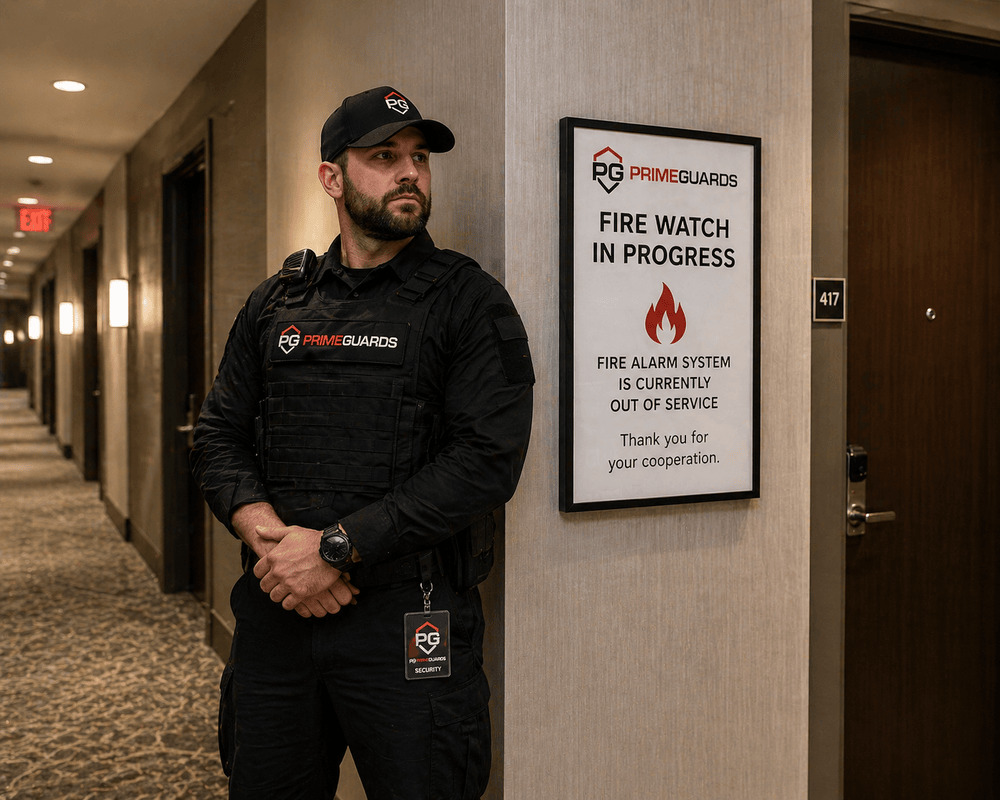
Each officer carries a thermal scanner, calibrated infrared thermometer, and digital tablet that logs every patrol with GPS coordinates and time stamps. Our guards walk every floor, roof, and mechanical room at 60 minute intervals, checking for heat build up, smoke, or blocked exits and immediately radio any anomaly to our operations center.
Real time reports are uploaded to a secure client portal, giving facility managers instant proof of compliance and insurers documented evidence of due diligence. One distribution center avoided a six figure fine after our overnight team detected a smoldering conveyor belt and initiated evacuation in under three minutes.
Hot Work Standby Guard
Sparks from welding, cutting, or grinding can smolder for hours before visible flames appear. PrimeGuards places a certified hot work standby guard beside your crew to enforce a 35 foot clear zone, position Class ABC extinguishers within arm’s reach, and maintain a continuous one hour fire watch after work stops.
Our officers log ambient temperature, wind speed, and completion times in a cloud based report that satisfies both fire marshal inspections and insurer audits. A recent client avoided a quarter million dollar roof loss when our guard detected embers inside insulation and doused them before the roofing crew left the site.
We coordinate with your permit holder, supply additional extinguishers at no charge, and file the final permit closure electronically, removing paperwork from your project timeline. Random arrival checks ensure welders never know when our guard will appear, reinforcing safe habits throughout the shift.
High-Rise Fire Watch Coverage
A single disabled sprinkler zone on the forty-second floor can place an entire tower on notice. PrimeGuards provides certified high-rise fire watch officers who begin coverage within two hours of your call and remain stationed until repairs are certified.
Each officer is assigned a specific bank of floors and conducts walking patrols every sixty minutes, verifying that exit doors are unlocked, stairwells are clear, and no unusual heat or smoke is present. Digital scan tags record time and location, giving building management instant proof of compliance for fire-marshal inspections.
Our guards carry handheld thermal imagers to detect heat build-up inside mechanical closets and above ceiling tiles before flames become visible. If an anomaly is found, they radio our operations center and initiate occupant notification procedures in accordance with your pre-fire plan.
Special Event Fire Watch
Outdoor festivals, product launches, and award shows introduce temporary kitchens, pyrotechnics, and tented dining areas that sit outside existing fire systems. PrimeGuards assigns certified special-event fire watch teams who inspect every booth, cable run, and cooking station before doors open.
Our officers verify that propane tanks are secured, electrical cords are GFCI-protected, and portable heaters maintain required clearances from tent walls. They position additional extinguishers near cooking zones and brief vendor staff on emergency procedures.
During the event, guards conduct continuous patrols, checking for overheated equipment, blocked exits, or audience members who wander into restricted areas. Real-time radio contact with event control allows immediate response to any ignition source before it escalates.
Fire Watch Security Services: Complete 2026 Compliance Guide
YMYL Safety Compliance: This fire watch guide has been professionally reviewed for accuracy and compliance with current NFPA standards, OSHA regulations, and municipal fire codes. PrimeGuards maintains all required state licenses, fire safety certifications, and comprehensive insurance coverage for professional fire watch operations nationwide. Information is updated regularly to reflect 2024-2026 code revisions.
Expert Review Panel: This article was authored by PrimeGuards’ Director of Fire Safety Operations, a Certified Protection Professional (CPP) with 15+ years in life safety management, and technically reviewed by a former municipal Fire Marshal holding NFPA Certified Fire Protection Specialist (CFPS) credentials. Our compliance team includes FDNY-certified Fire Guards (F-01, F-60), OSHA 30-hour certified supervisors, and licensed security professionals.
This compliance resource is continuously audited and maintained by our expert review panel to reflect current NFPA and OSHA safety standards
What Is Fire Watch Security?
The Official NFPA Definition and Standards
Fire watch security represents a critical temporary life safety measure deployed when standard fire protection systems become impaired or when specific high-risk operations require enhanced monitoring. According to the National Fire Protection Association (NFPA), a fire watch constitutes a systematic patrol conducted by qualified personnel to identify and mitigate fire hazards, detect early signs of fire initiation, and initiate immediate emergency response protocols when standard detection or suppression systems are offline or insufficient.
Under NFPA 101, the Life Safety Code, fire watch services are not merely recommended procedures but mandatory requirements that activate automatically when fire alarms, sprinkler systems, or other suppression equipment experience failures. The standard mandates continuous patrols of affected areas by trained individuals who possess the authority and capability to detect fire conditions, sound alarms, notify building occupants, and contact emergency responders without delay.
Fire Watch vs. Fire Guard vs. Security Guard: Understanding the Differences
While these terms are sometimes used interchangeably in casual conversation, they represent distinct roles with different responsibilities, training requirements, and legal authorities. Understanding these differences is essential for building managers, construction supervisors, and facility directors who must ensure proper life safety compliance.
A fire watch guard is a trained individual assigned to patrol areas where fire protection systems are impaired or where hot work operations create elevated fire risks. Their duties are strictly defined by fire code and include specific patrol intervals, documentation requirements, and communication protocols with the fire department. Fire watch guards must have no other duties during their patrols (the “sole responsibility” rule) and must maintain continuous alertness throughout their shift.
A fire guard typically refers to personnel holding specific municipal certifications, particularly in jurisdictions like New York City where the Fire Department of New York (FDNY) issues specific license types (F-01, F-02, F-03, F-04, F-60). These individuals undergo specialized training through FDNY-approved providers and carry cards certifying their qualifications for specific venues such as public assemblies, shelters, or hot work operations.
A security guard, while responsible for general property protection and access control, does not automatically possess fire watch authority unless specifically trained and assigned. Security personnel may perform fire watch duties only when they receive specialized training in fire detection, evacuation procedures, and the specific impairment protocols applicable to the building or site. Simply posting a standard security guard without fire watch training does not satisfy code requirements.
Historical Context and Evolution of Fire Watch Services
The concept of fire watch predates modern electronic detection systems by centuries. In medieval European cities, night watchmen patrolled streets with bells and lanterns to detect fires before they could spread to adjacent wooden structures. During World War II, civil defense organizations maintained rooftop fire watches to spot incendiary devices and early ignition sources in major industrial cities.
Modern fire watch protocols emerged systematically following catastrophic fires in high-occupancy buildings during the mid-20th century. The development of NFPA 101 and subsequent fire safety codes transformed fire watch from an ad-hoc practice into a standardized, regulated procedure with specific training mandates, patrol intervals, and documentation requirements. Today’s digital logging systems, NFC-enabled patrol verification, and real-time reporting capabilities represent significant technological advances, yet the fundamental mission remains unchanged: human vigilance as the final safety net when automated systems fail.
Why Fire Watch Is Essential for Life Safety
Fire watch services serve as the critical human backup when technological fire protection systems experience failures. Building fire alarms and automatic sprinkler systems detect and suppress fires within minutes, saving lives and property through rapid response. When these systems become impaired due to maintenance, construction, water supply disruptions, or equipment failures, the risk to occupants increases dramatically.
Statistics from the National Fire Protection Association indicate that buildings with impaired suppression systems experience fire growth rates 300% faster than protected structures during the critical first ten minutes of ignition. Without automatic detection, a fire can grow undetected until it reaches flashover conditions, trapping occupants and overwhelming manual suppression efforts. Fire watch guards provide the essential human surveillance that bridges this dangerous gap, detecting smoke, flame, or heat conditions at their earliest stages and initiating evacuation and response protocols immediately.
Relationship to Building Fire Protection Systems
Fire watch does not replace or duplicate automatic fire protection systems; rather, it serves as a temporary substitute when those systems cannot perform their intended functions. A properly designed building fire protection strategy includes detection (smoke and heat alarms), suppression (sprinklers, standpipes), notification (horns, strobes, voice evacuation), and compartmentalization (fire-rated walls and doors). When any of these elements become impaired, fire watch personnel assume the detection and notification functions until repairs restore system integrity.
This relationship requires close coordination between fire watch providers, building engineers, fire alarm contractors, and local fire marshals. Fire watch guards must understand the specific systems that are impaired, the areas affected, the expected duration of the impairment, and the escalation protocols established in the building’s fire safety plan. They serve as the communication link between the impaired building systems and the fire department, ensuring that first responders receive immediate notification if conditions deteriorate.
Essential Fire Watch Terminology
Understanding fire watch requirements necessitates familiarity with specific technical terms used throughout NFPA standards and municipal fire codes:
Authority Having Jurisdiction (AHJ): This term refers to the specific individual or organization responsible for enforcing fire codes within a given area. The AHJ may be a municipal fire marshal, building official, fire prevention bureau, or insurance representative. The AHJ maintains final approval authority over fire watch implementation, including patrol intervals, personnel qualifications, and documentation standards.
Permit Authorizing Individual (PAI): Required under NFPA 51B for hot work operations, the PAI is a qualified person designated by the building or site owner to authorize issuance of hot work permits. The PAI ensures that fire watch personnel are assigned, combustible materials are protected or removed, and pre-work safety inspections are completed before welding, cutting, or grinding operations commence.
Impairment: This refers to any condition where a fire protection system is out of order, shut off, or operating below required capacity. Impairments are classified as either “emergency” (sudden failures) or “planned” (scheduled maintenance). NFPA 25 and NFPA 72 establish specific time limits (4-hour rule for alarms, 10-hour rule for sprinklers) before fire watch must be implemented.
Hot Work: Any operation involving open flames, welding, cutting, grinding, or heat-producing tools capable of igniting combustible materials. Hot work creates sparks that can travel 35 feet or more, requiring dedicated fire watch coverage during operations and for specified periods (typically 30 minutes to 2 hours) after work concludes.
Patrol Interval: The maximum time permitted between complete inspections of all areas under fire watch coverage. Depending on occupancy type and hazard level, intervals may be 15 minutes (hospitals, assembly occupancies), 30 minutes (standard commercial), or 60 minutes (vacant structures or specific jurisdictions).
Fire Watch Legal Requirements and Building Codes
NFPA Standards and Fire Watch Compliance
The National Fire Protection Association establishes the foundational standards governing fire watch protocols across the United States. While NFPA standards themselves are not laws, they are incorporated by reference into municipal fire codes, building codes, and state regulations, effectively making them legally enforceable requirements. Understanding these standards is essential for maintaining compliance and avoiding violations that can result in substantial penalties or business closure.
NFPA 101, the Life Safety Code, serves as the primary document establishing when and where fire watch is required. Chapter 9 of NFPA 101 specifically addresses fire protection systems and their impairments. When fire alarm systems, sprinkler systems, or other suppression equipment become inoperative, the code mandates immediate implementation of temporary fire safety measures. The standard requires that fire watch personnel conduct systematic patrols of all affected areas, maintain continuous vigilance, and possess the capability to immediately notify occupants and the fire department upon detection of fire conditions.
NFPA 25, the Standard for the Inspection, Testing, and Maintenance of Water-Based Fire Protection Systems, establishes specific timeframes for fire watch implementation when sprinkler systems experience impairments. Under Section 15.5 of NFPA 25, any building with an impaired sprinkler system must implement fire watch within 10 hours of the impairment occurring. This “10-hour rule” applies to partial impairments affecting specific zones as well as total system shutdowns. The standard requires building owners to notify the fire department immediately when a sprinkler system becomes impaired and to maintain fire watch until the system is fully restored to service.
NFPA 72, the National Fire Alarm and Signaling Code, establishes similar requirements for fire alarm system impairments. Section 10.19 of NFPA 72 mandates fire watch implementation within 4 hours when fire alarm systems are impaired. This more stringent timeframe reflects the critical importance of early fire detection in occupant notification and safe evacuation. The standard requires that fire watch personnel patrol all areas served by the impaired detection system at intervals not exceeding 30 minutes, or more frequently as required by the Authority Having Jurisdiction (AHJ).
NFPA 51B, the Standard for Fire Prevention During Welding, Cutting, and Other Hot Work, governs fire watch requirements for construction and maintenance operations. This standard mandates that a trained fire watch be posted during all hot work operations and for a minimum of 60 minutes following the completion of work. For operations involving torch-applied roofing or other high-risk applications, the post-work fire watch period extends to 2 hours. NFPA 51B requires the fire watch to be equipped with at least one 2A10BC rated fire extinguisher and to have no other duties while hot work is being performed.
NFPA 241, the Standard for Safeguarding Construction, Alteration, and Demolition Operations, establishes fire watch requirements for buildings under construction or demolition. Section 8.5 of NFPA 241 requires fire watch personnel whenever temporary heating equipment is in operation, when welding or cutting is performed, or when buildings exceed 40 feet in height during construction. The standard specifically addresses the unique hazards present in unfinished structures, including incomplete sprinkler systems, open stairwells, and accumulated combustible construction debris.
NFPA 601, the Standard for Security Services in Fire Loss Prevention, provides guidance for security personnel who may be assigned fire watch duties. While primarily addressing security operations, this standard establishes training requirements for guards who monitor buildings for fire hazards, including recognition of fire conditions, operation of alarm systems, and emergency notification procedures. Security officers performing fire watch must meet the same qualifications as dedicated fire watch personnel and cannot perform security duties simultaneously with fire watch responsibilities.
OSHA Regulations and Fire Watch Mandates
The Occupational Safety and Health Administration (OSHA) establishes federal requirements for fire watch in workplace settings, particularly during hot work operations. Unlike NFPA standards, OSHA regulations carry the force of federal law and are enforced through workplace safety inspections that can result in citations and significant financial penalties.
OSHA 29 CFR 1910.252, Subpart Q (Welding, Cutting, and Brazing), establishes comprehensive fire watch requirements for general industry operations. The standard requires that fire watch personnel be stationed within the immediate vicinity of welding or cutting operations when flammable materials are present within 35 feet of the work area. The fire watch must remain in place for at least 30 minutes after welding operations conclude to detect any smoldering fires that may develop from delayed ignition of combustible materials.
OSHA 1910.252 mandates that employers establish written fire watch procedures as part of their hot work permit program. These procedures must specify the qualifications required for fire watch personnel, the equipment they must carry (including fire extinguishers and communication devices), and the specific areas requiring monitoring. The standard explicitly prohibits fire watch personnel from performing other duties while hot work is in progress, establishing the “sole responsibility” requirement that prevents employers from assigning additional tasks to fire watch guards.
For construction operations, OSHA 29 CFR 1926 Subpart R establishes similar fire watch requirements specifically tailored to construction site conditions. The construction standard recognizes the heightened fire risks present in incomplete structures and mandates fire watch not only during welding and cutting but also during any operations involving open flames or heat-producing equipment. Construction fire watch personnel must be familiar with site evacuation procedures and maintain constant communication with site supervisors and local emergency services.
OSHA requires that fire watch personnel receive specific training in fire detection, use of portable fire extinguishers, and emergency notification procedures. While OSHA does not mandate specific certification programs, the agency requires that training be documented and that personnel demonstrate competency in their assigned duties. Violations of OSHA fire watch requirements can result in penalties of up to $136,532 per willful violation, with serious violations carrying fines up to $13,653 per occurrence.
International Fire Code (IFC) and Municipal Requirements
The International Fire Code (IFC), published by the International Code Council, serves as the foundation for municipal fire codes in most major jurisdictions across the United States. While local amendments are common, the IFC establishes baseline requirements that local fire marshals enforce through regular inspections and violation citations.
IFC Section 3304.5 specifically addresses fire watch requirements for construction and demolition sites. The code requires fire watch personnel whenever temporary heating devices are used, during welding and cutting operations, and in buildings exceeding 40 feet in height during construction. The standard mandates that fire watch logs be maintained on-site and made available to fire code officials upon request, with records retained for a minimum of one year following project completion.
IFC Section 605.5 establishes requirements for fire protection system impairments, mandating that building owners notify the fire code official immediately when any fire alarm, sprinkler, or standpipe system becomes inoperative. The code requires fire watch implementation within the timeframes established by NFPA 25 and NFPA 72, with local amendments potentially requiring more stringent intervals. Many jurisdictions modify this section to require fire watch notification to the fire department within 30 minutes of system impairment, significantly shorter than the NFPA 10-hour allowance.
The Authority Having Jurisdiction (AHJ) maintains significant discretion under the IFC to establish site-specific fire watch requirements based on local conditions. Fire marshals may require 15-minute patrol intervals in high-risk occupancies even when 30-minute intervals would satisfy NFPA standards. They may mandate additional fire extinguishers, require radio communication with fire department dispatch, or establish specific qualifications for fire watch personnel beyond state minimums. Building owners and contractors must coordinate with local fire prevention bureaus to understand jurisdiction-specific amendments that may exceed baseline code requirements.
| Code/Standard | Primary Application | Key Fire Watch Requirement |
|---|---|---|
| NFPA 101 | Life Safety (All Occupancies) | Mandatory patrols during system impairments |
| NFPA 25 | Sprinkler System Impairments | 10-hour maximum before fire watch required |
| NFPA 72 | Fire Alarm System Impairments | 4-hour maximum before fire watch required |
| NFPA 51B | Hot Work Operations | 60-minute post-work fire watch minimum |
| NFPA 241 | Construction/Demolition | Required for buildings over 40 feet height |
| OSHA 1910.252 | General Industry Hot Work | 30-minute post-work fire watch minimum |
| OSHA 1926 | Construction Hot Work | Fire watch during all open flame operations |
| IFC 3304.5 | Construction Site Safety | Site-specific fire watch protocols required |
| IFC 605.5 | System Impairments | Immediate notification to fire code official |
Critical Compliance Note: Recent 2024 code updates emphasize that fire watch personnel must have no other duties during their patrols. Violations of this “sole responsibility” rule now carry enhanced penalties in many jurisdictions, with some fire marshals treating dual-duty assignments as equivalent to having no fire watch at all. PrimeGuards assigns dedicated fire watch specialists who perform no other security or maintenance functions during their shifts.
Fire Watch Triggers: When You Must Deploy Guards
System Impairments and Fire Protection Failures
Fire watch becomes mandatory whenever building fire protection systems experience impairments that compromise their ability to detect or suppress fires. Understanding the specific triggers and timeframes for fire watch implementation is critical for facility managers, building owners, and construction supervisors who must maintain continuous life safety coverage.
Fire Alarm System Failures (The 4-Hour Rule): Under NFPA 72, fire watch must be implemented within 4 hours when fire alarm systems become impaired. This includes total system failures, partial zone impairments, trouble conditions affecting notification appliances, or loss of monitoring connection to the supervising station. The 4-hour window is significantly shorter than the sprinkler impairment allowance because alarm systems provide the critical early warning necessary for safe occupant evacuation.
When fire alarm systems are impaired, fire watch personnel assume the detection and notification functions normally performed by smoke detectors, heat sensors, and alarm notification appliances. Guards must patrol all areas served by the impaired detection circuits at intervals not exceeding 30 minutes, or more frequently as required by the local Authority Having Jurisdiction. They must carry communication devices capable of immediately contacting the fire department and have the authority to initiate building evacuation upon detection of fire conditions.
Sprinkler System Outages (The 10-Hour Rule): NFPA 25 establishes a 10-hour maximum timeframe for implementing fire watch when water-based fire protection systems become impaired. This applies to wet pipe systems, dry pipe systems, pre-action systems, deluge systems, and foam-water sprinkler systems. The 10-hour rule applies whether the impairment is planned (scheduled maintenance) or emergency (pipe rupture, water supply interruption, or pump failure).
During sprinkler impairments, fire watch personnel serve as the primary defense against fire spread until water-based suppression capabilities are restored. Guards must be equipped with appropriate portable fire extinguishers (minimum 2A10BC rating) and understand the specific areas affected by the impairment. Many jurisdictions require that fire watch logs during sprinkler outages document not only patrol times but also verification that fire department connections remain accessible and that standpipe systems (if operational) are ready for fire department use.
Standpipe System Impairments: When building standpipe systems experience impairments, fire watch requirements intensify because firefighters lose their primary water supply for interior fire attack. High-rise buildings, malls, and large commercial structures depend on standpipes to deliver water to upper floors and remote areas. Impairments require immediate fire watch implementation, often with 15-minute patrol intervals in high-rise structures, because the building essentially loses its internal firefighting infrastructure.
Fire Pump Failures: Fire pumps provide the pressure necessary to deliver adequate water flow to sprinkler and standpipe systems. When electric fire pumps, diesel fire pumps, or jockey pumps fail, the entire water-based suppression system becomes compromised. Fire watch must be implemented immediately upon pump failure, with particular attention to areas at the extremities of the piping system where pressure losses will be most severe. Guards should verify that fire department connections are clearly marked and accessible for fire department pumper operations.
Water Supply Disruptions: Any interruption to the water supply serving fire protection systems triggers fire watch requirements. This includes municipal water main breaks, private well failures, tank depletions, or valve closures that isolate fire protection piping. Even temporary disruptions for plumbing repairs can necessitate fire watch if the impairment exceeds the permitted timeframes. Facility managers must coordinate with water utilities and fire protection contractors to minimize outage durations and ensure continuous fire watch coverage during repairs.
Emergency vs. Planned Impairments: Fire codes distinguish between emergency impairments (sudden, unplanned failures) and planned impairments (scheduled maintenance or renovations). While both require fire watch, planned impairments allow for pre-positioning of fire watch personnel and coordination with the fire department before the impairment occurs. Emergency impairments require immediate response, often necessitating 24/7 emergency fire watch services that can deploy guards within hours to maintain compliance.
Level 1 vs. Level 2 Impairments: NFPA 25 classifies impairments by severity. Level 1 impairments affect entire systems or large portions of buildings, requiring comprehensive fire watch coverage of all affected areas. Level 2 impairments are localized (single sprinkler head, isolated zone), potentially allowing for reduced fire watch scope if the impaired area can be effectively isolated and monitored. However, the Authority Having Jurisdiction maintains final approval over the extent of fire watch coverage required for any impairment.
Hot Work Operations and Temporary Fire Hazards
Hot work operations create intense, localized fire risks that require dedicated fire watch coverage beyond standard building protection systems. Unlike system impairments, which involve loss of protection, hot work introduces new ignition sources into environments where combustible materials may be present.
Welding, Cutting, Grinding, and Torching: Any operation producing sparks, slag, or heat sufficient to ignite combustible materials constitutes hot work requiring fire watch. This includes arc welding, oxy-acetylene cutting, plasma cutting, grinding with abrasive wheels, and torch-applied roofing operations. The NFPA 51B 35-foot rule mandates fire watch whenever combustible materials are located within 35 feet of hot work operations, or when walls, partitions, or other barriers within that radius have combustible construction or coverings.
The Permit Authorizing Individual (PAI): NFPA 51B requires that each site designate a Permit Authorizing Individual responsible for evaluating hot work hazards and issuing formal hot work permits. The PAI must inspect the work area before operations commence, verify that fire watch personnel are assigned and equipped, ensure combustible materials are protected or relocated, and confirm that sprinkler systems are operational (unless specifically impaired as part of the work). The PAI maintains authority to suspend hot work operations if fire watch personnel are absent or if unsafe conditions develop during work.
Hot Work Permits and Documentation: Formal hot work permits document the specific location, time, type of work, and fire watch assignments for each operation. Permits specify the duration of required post-work fire watch and identify the PAI who authorized the work. Many jurisdictions require that hot work permits be posted at the job site and that copies be maintained by the building owner for inspection by fire marshals. PrimeGuards fire watch personnel carry copies of current permits and verify that permit conditions are satisfied before hot work begins.
Post-Work Fire Watch Durations: The required duration of fire watch following hot work completion varies by operation type and jurisdiction. Standard welding and cutting operations require a minimum 30-minute post-work fire watch under OSHA 1910.252, while NFPA 51B mandates 60 minutes for general hot work. Torch-applied roofing and similar high-risk operations require 2-hour post-work fire watches under NFPA 241, because bitumen and roofing materials can retain heat and smolder for extended periods before visible flames appear.
Fire watch personnel must remain in the immediate vicinity of hot work operations throughout the work period and cannot leave the area until the specified post-work surveillance period is completed. They must examine the work area and adjacent spaces (including areas below, above, and behind walls where sparks may have traveled) for signs of smoldering or ignition before concluding their watch.
Construction and Demolition Fire Watch Requirements
Buildings under construction or demolition present unique fire hazards that standard fire protection systems cannot adequately address. Incomplete structures lack compartmentalization, automatic detection, and suppression systems, while demolition creates combustible debris and exposes hidden hazards.
Buildings Exceeding 40 Feet in Height: NFPA 241 and the International Fire Code require continuous fire watch in buildings under construction that exceed 40 feet in height. As buildings rise, evacuation becomes more complex and fire department access more challenging. Fire watch personnel in high-rise construction provide early detection, assist with worker evacuation, and guide fire department operations when systems are not yet operational. Many jurisdictions extend this requirement to buildings exceeding 25 feet or three stories, depending on local amendments.
Temporary Heating Operations: Construction sites frequently use temporary heating equipment during cold weather, including salamander heaters, propane torches, and electric heating units. NFPA 241 Section 8.5 mandates fire watch whenever temporary heating devices are in operation, regardless of building height. Guards must verify that heaters maintain required clearances from combustible materials, that fuel supplies are properly secured, and that heating equipment is shut down at shift end.
Demolition Fire Watch Requirements: Demolition operations expose hidden combustible materials, disrupt existing fire protection systems, and create dust conditions that can ignite from cutting torches or electrical faults. Fire watch during demolition focuses on monitoring for smoldering debris, ensuring water supplies are available for dust suppression, and preventing ignition of accumulated materials. Demolition sites with hazardous materials (asbestos, chemical residues) require specialized fire watch personnel trained in hazardous material recognition and emergency response.
PrimeGuards Construction Fire Watch Services
Our construction fire watch teams specialize in high-rise building sites, demolition projects, and temporary heating operations. We provide 24/7 coverage with guards trained in NFPA 241 requirements, hot work permitting, and construction site hazard recognition. All personnel carry 2A10BC fire extinguishers, two-way radios with direct fire department contact capability, and complete detailed logs meeting municipal inspection standards.
Special Events and Assembly Occupancies
Public gatherings introduce elevated fire risks due to increased occupant loads, temporary structures, pyrotechnic displays, and unfamiliarity with venue emergency procedures. Fire marshals frequently mandate dedicated fire watch for events exceeding normal occupancy thresholds or involving special hazards.
Public Assembly Events: Events in assembly occupancies (theaters, concert halls, arenas, convention centers) that exceed normal operating capacities or modify standard seating configurations often require supplemental fire watch personnel. Guards monitor exit routes to prevent blockages, verify that fire doors remain closed, and assist with crowd management during emergencies. Fire watch for assembly occupancies typically requires 15-minute patrol intervals due to the high occupant load and potential for rapid panic conditions.
Concerts and Pyrotechnic Displays: Indoor concerts utilizing pyrotechnics, flames, or spark effects require extensive fire watch coverage before, during, and after performances. Fire watch personnel inspect pyrotechnic devices, verify clearances from combustible stage materials, monitor rigging and drapery, and ensure that fire curtains and smoke vents operate properly. Post-event fire watch examines the stage and audience areas for delayed ignition of debris or equipment.
Trade Shows and Exhibitions: Convention centers hosting trade shows with extensive electrical installations, booth construction, and demonstration activities frequently require dedicated fire watch, particularly during setup and teardown phases when sprinkler systems may be temporarily impaired or when booth construction involves hot work. Fire watch personnel monitor for overloaded electrical circuits, improper storage of combustible booth materials, and blocked egress paths through exhibition aisles.
Crowd Management Considerations: Fire watch personnel at special events serve dual functions: fire safety monitoring and crowd management support. They must recognize when occupant densities approach dangerous levels, identify exit route obstructions caused by merchandise displays or temporary seating, and coordinate with event security and local fire departments if evacuation becomes necessary. Training for event fire watch includes crowd psychology, emergency communication systems, and evacuation assistance for persons with disabilities.
Compliance Alert: Many jurisdictions now require that fire watch for special events be provided by certified fire guards rather than general security personnel. New York City, Chicago, and Las Vegas mandate FDNY-certified or equivalent fire guards for public assemblies exceeding specific occupant thresholds. Using uncertified personnel can result in immediate event shutdown and significant municipal fines.
Types of Fire Watch Security Services
Continuous Fire Watch (24/7 Coverage)
Continuous fire watch provides uninterrupted monitoring around the clock for situations requiring sustained life safety coverage. This service type applies to extended sprinkler system impairments, long-term construction projects, or buildings with chronic fire protection deficiencies that cannot be immediately resolved. Continuous coverage ensures that no gap exists in fire monitoring, regardless of time of day or day of week.
Continuous fire watch typically operates on rotating shifts to prevent guard fatigue and maintain alertness. Standard practice utilizes 8-hour or 12-hour shifts with overlapping coverage during shift changes to eliminate gaps. Each arriving guard receives detailed briefings from the outgoing shift regarding current conditions, specific hazards, recent incidents, and communication protocols. Supervisors conduct regular spot checks during all shifts to verify that patrol intervals are maintained and that logs are completed accurately.
Buildings requiring continuous fire watch include hospitals with impaired suppression systems, high-rise residential buildings during fire pump replacements, hotels with inoperative alarms undergoing renovation, and construction sites approaching substantial completion where partial occupancy occurs before full system activation. Insurance carriers frequently mandate continuous fire watch for these scenarios, and failure to maintain uninterrupted coverage can result in policy cancellation or claims denial.
Business Hours Fire Watch
Business hours fire watch provides coverage during operational periods when buildings are occupied, allowing suspension of patrols during unoccupied overnight hours if permitted by the Authority Having Jurisdiction. This service type applies primarily to commercial office buildings, retail establishments, and industrial facilities with planned impairments that can be scheduled during low-occupancy periods.
The business hours model reduces costs while maintaining safety during periods of actual risk. Fire marshals may approve business hours-only fire watch for impairments affecting non-critical systems in buildings with good fire separation, reliable alarm systems in unaffected zones, and limited overnight occupancy. However, approval requires demonstration that the building remains safe during unpatrolled hours through alternative measures such as enhanced alarm monitoring, security guard presence, or temporary detection systems.
Implementation requires careful coordination with building schedules. Guards arrive before the first occupants enter and maintain coverage until the last persons leave. For buildings with staggered shifts or 24-hour operations in limited areas, fire watch may cover only occupied zones while unoccupied sections remain secured and monitored through alternative means. Documentation must clearly distinguish between patrolled and unpatrolled periods, with specific risk assessments justifying reduced coverage.
Hot Work Fire Watch (Specialized Operations)
Hot work fire watch represents the most common type of specialized fire watch, specifically tailored to welding, cutting, and heat-producing construction activities. Unlike general impairment fire watch, which monitors for system failures, hot work fire watch actively monitors ignition sources and prevents fires from starting.
This service type requires guards with specific training in construction hazards, spark travel patterns, and delayed ignition recognition. Hot work fire watch personnel maintain visual contact with the work area throughout operations and continue surveillance for the mandated post-work period (30 minutes to 2 hours depending on operation type). They carry Class ABC fire extinguishers and often additional water-type extinguishers for Class A combustible materials common at construction sites.
Hot work fire watch operates under the authority of the Permit Authorizing Individual (PAI) and must be in place before the PAI issues the hot work permit. Guards have explicit authority to stop work immediately if they observe unsafe conditions, inadequate clearances, or violations of permit conditions. This authority makes hot work fire watch guards active participants in safety management rather than passive observers.
PrimeGuards provides specialized hot work fire watch for roofing contractors, steel erection companies, facility maintenance teams, and demolition contractors. Our personnel understand the specific requirements of NFPA 51B and OSHA 1910.252, including the 35-foot rule for combustible clearances and the extended surveillance periods required for torch-applied roofing and similar high-risk operations.
Emergency Fire Watch Response
Emergency fire watch addresses sudden, unplanned impairments requiring immediate deployment of qualified personnel. When sprinkler pipes rupture, fire alarms fail unexpectedly, or construction accidents damage fire protection systems, building owners face immediate compliance deadlines measured in hours rather than days.
PrimeGuards maintains 24/7 emergency dispatch capabilities to deploy fire watch teams within 2 to 4 hours of initial contact. Emergency response includes rapid assessment of the affected area, determination of required patrol intervals based on occupancy and hazard level, establishment of communication protocols with the fire department, and initiation of documentation systems to maintain compliance from the first patrol.
Emergency fire watch frequently transitions to scheduled coverage once the immediate crisis stabilizes. During the emergency phase, guards may work extended hours or overtime shifts to ensure continuous coverage until relief personnel arrive. PrimeGuards coordinates with fire protection contractors to align fire watch duration with repair schedules, reducing costs by demobilizing teams as soon as systems return to service and authorities approve restoration.
Temporary vs. Long-Term Fire Watch
Temporary fire watch covers short-duration impairments lasting from a few hours to several days. This category includes planned maintenance shutdowns, emergency repairs, and brief system malfunctions. Temporary assignments typically involve limited guard rotations and simplified documentation, though safety standards remain identical to long-term coverage.
Long-term fire watch addresses chronic system deficiencies, extended construction projects, or buildings undergoing major renovations lasting weeks or months. Long-term coverage requires sophisticated scheduling systems, multiple guard teams, supervisor oversight, and regular coordination with fire marshals to adjust requirements as conditions change. Long-term fire watch often involves integration with building management systems, digital logging platforms, and weekly compliance reporting to stakeholders and authorities.
The distinction between temporary and long-term affects cost structures, personnel assignments, and documentation retention. Temporary fire watch may utilize a single guard or small team throughout the assignment, while long-term coverage requires bench strength to handle vacations, illnesses, and turnover without coverage gaps. Documentation for long-term fire watch must be meticulously organized for potential fire marshal inspections months after the assignment concludes.
Fire Watch and Security Guard Combination Services
Some clients require personnel who can perform both fire watch and traditional security functions simultaneously. While fire codes generally prohibit fire watch personnel from performing other duties during their patrols, certain low-risk scenarios may allow limited combination roles with specific approvals from the Authority Having Jurisdiction.
Combination services work best for vacant buildings with impairment-related fire watch requirements but minimal security threats. In these scenarios, the primary role remains fire watch, with security functions (access control, perimeter checks) performed only when the guard is stationary at a post with visual coverage of the protected area. Patrols for fire detection cannot be interrupted to respond to security alarms or escort contractors.
PrimeGuards evaluates each combination request against code requirements and risk levels. We refuse combination assignments where fire watch responsibilities would be compromised by security duties, particularly in occupied buildings, high-hazard occupancies, or situations requiring frequent patrols. When combination services are approved, we clearly document the scope of each function and ensure that fire watch always takes precedence over secondary responsibilities.
Digital and Technology-Enhanced Fire Watch
Modern fire watch increasingly incorporates technology to supplement human patrols. Digital logging systems replace paper logs, utilizing NFC tags, QR codes, or GPS verification to confirm that guards complete patrol routes at required intervals. Real-time reporting allows supervisors to monitor patrol compliance remotely and receive immediate alerts if intervals are missed.
Some facilities supplement live patrols with thermal imaging cameras, smoke detection systems in impaired zones, or video analytics that detect flame or smoke signatures. These technologies can enhance fire watch effectiveness but cannot replace human judgment, decision-making, or the ability to intervene physically. Fire codes universally require human fire watch personnel regardless of technological supplements.
PrimeGuards utilizes digital logging platforms that provide clients with real-time access to patrol data, automated compliance reports, and documentation storage. Our guards use ruggedized mobile devices to record patrol timestamps, photograph hazards, and communicate with supervisors. This technology reduces paperwork errors, eliminates disputes about whether patrols occurred, and simplifies fire marshal inspections by providing instantly retrievable digital records.
| Service Type | Best For | Typical Duration | Special Requirements |
|---|---|---|---|
| Continuous 24/7 | Extended impairments, construction, hospitals | Days to months | Rotating shifts, no coverage gaps |
| Business Hours Only | Office buildings, planned maintenance | Hours to days | AHJ approval for unoccupied hours |
| Hot Work Specialist | Welding, cutting, torching operations | Hours per permit | Post-work surveillance, PAI coordination |
| Emergency Response | Sudden system failures | 2-4 hour deployment | Immediate NFPA/OSHA compliance |
| Long-Term Coverage | Major renovations, chronic deficiencies | Weeks to months | Multiple teams, digital logging, reporting |
| Security Combination | Vacant buildings, low-risk scenarios | Variable | AHJ approval, fire watch priority |
Selecting the Right Fire Watch Service
PrimeGuards evaluates each client’s specific situation to recommend the appropriate service type. Factors include the nature of the impairment, occupancy type, local fire code requirements, insurance carrier stipulations, and budget considerations. We provide transparent pricing for each service model and adjust coverage types as conditions evolve, ensuring you never pay for unnecessary coverage while maintaining absolute compliance.
Fire Watch Guard Duties and Responsibilities
Core Duties of Fire Watch Personnel
Fire watch guards serve as the primary human defense against fire initiation and spread when automatic systems are impaired. Their duties extend far beyond simple observation, encompassing active hazard identification, immediate emergency response, and continuous documentation of conditions. Understanding these core responsibilities is essential for both the guards performing the work and the facility managers supervising compliance.
Continuous Monitoring and Surveillance: The fundamental duty of fire watch is unwavering attention to the protected area. Guards must maintain continuous awareness of conditions, sounds, smells, and visual cues indicating potential fire hazards. Unlike security guards who may have routine patrol patterns with downtime between rounds, fire watch requires sustained alertness throughout the entire shift. This means no reading, no personal phone use, no napping, and no engaging in conversations that distract from environmental monitoring. The guard’s sole purpose is to detect fire conditions at the earliest possible moment.
During continuous monitoring, guards utilize all senses. They watch for smoke, flames, or unusual light reflections. They listen for crackling sounds, popping from electrical faults, or alarm bells from other building areas. They smell for smoke, burning insulation, or chemical vapors. In hot work scenarios, they maintain visual contact with the work area and monitor for sparks traveling beyond the immediate work zone. This multi-sensory vigilance catches fires during incipient stages when portable extinguishers remain effective.
Patrol Routes and Zone Coverage: Fire watch requires systematic patrol of all areas within the impaired zone. Guards follow established routes ensuring complete coverage of every room, corridor, storage area, and mechanical space affected by the fire protection system outage. Patrol intervals vary based on occupancy type: 15 minutes for hospitals and assembly occupancies, 30 minutes for standard commercial buildings, and up to 60 minutes for vacant structures or specific low-risk scenarios as approved by the Authority Having Jurisdiction.
Effective patrol routes minimize time between inspections of high-hazard areas while ensuring no space remains unobserved for longer than the mandated interval. Guards carry route maps showing patrol sequences, timing requirements, and specific checkpoints requiring documentation. They vary timing slightly on successive patrols to prevent predictable patterns, as fires could potentially develop in rhythm with fixed schedules. During each patrol, guards physically enter spaces, look behind doors, check above ceilings where accessible, and verify that fire doors remain closed and clear.
Fire Hazard Identification: Beyond detecting active fires, guards identify conditions that could lead to fires. During system impairments, they enforce heightened housekeeping standards, ensuring that combustible materials are not accumulating in corridors, that electrical panels remain accessible, and that temporary heating devices maintain proper clearances. They verify that fire extinguishers remain in place, charged, and unobstructed.
In hot work scenarios, hazard identification includes verifying the 35-foot clear zone around welding and cutting operations is free of combustibles, ensuring that fire-resistant blankets properly protect walls and openings, and confirming that flammable liquid containers are sealed and removed from the work area. Guards have authority to stop work immediately if they observe violations of hot work permits, unsafe accumulations of debris, or impairment of egress routes.
Communication with Fire Department: Fire watch guards serve as the communication link between the impaired building and emergency responders. They must have immediate access to working telephones or two-way radios capable of contacting 911 or the local fire department dispatch without delay. Many jurisdictions require that guards test communication devices at the start of each shift and maintain backup communication methods in case primary systems fail.
Upon detecting smoke, fire, or hazardous heat conditions, the guard’s first action is notification of the fire department. This takes precedence over firefighting efforts or building evacuation because rapid professional response saves lives and property. Guards provide dispatchers with specific address information, floor or zone locations, nature of the emergency, and conditions of any trapped occupants. They remain on communication channels to guide arriving firefighters to the incident location, providing critical information about impaired systems, building layout, and potential hazards.
Emergency Response Initiation: While notification takes priority, fire watch guards are trained to initiate appropriate emergency response actions. This includes sounding manual fire alarms if the automatic system is impaired, activating building evacuation signals, and notifying occupants in the immediate hazard area. Guards carry keys or access credentials to all areas under watch, ensuring they can quickly reach potential fire locations without delay.
Guards are trained in portable fire extinguisher use, specifically the PASS technique (Pull, Aim, Squeeze, Sweep). However, they are explicitly instructed to attempt extinguishment only when: the fire is small and contained (incipient stage), they have appropriate extinguisher types for the fuel involved, their escape route remains clear, and the fire department has already been notified. If any of these conditions are not met, the guard’s role becomes evacuation assistance and scene security rather than firefighting.
Evacuation Assistance: When evacuation becomes necessary, fire watch personnel assist building occupants in safely exiting the structure. This includes directing people to nearest exits, assisting persons with disabilities, ensuring that exit routes remain clear of smoke or fire, and preventing re-entry until authorities declare the building safe. Guards perform sweep checks of restrooms, offices, and other spaces to ensure no occupants remain behind.
In healthcare facilities, evacuation assistance becomes particularly critical as staff relocate patients who cannot walk. Fire watch guards support these efforts by ensuring exit corridors remain tenable, holding fire doors open during movement, and directing traffic flow to prevent congestion. Their knowledge of the specific impairment zone helps staff understand which evacuation routes remain protected by functional systems and which require special caution.
Authority to Stop Work: Fire watch guards assigned to hot work operations possess explicit authority to stop work immediately when they identify unsafe conditions. This authority comes from NFPA 51B and the Permit Authorizing Individual who issued the hot work permit. Guards can halt operations for combustibles within the 35-foot zone, fire watch interruptions, failure of fire extinguisher equipment, or any violation of permit conditions.
When stopping work, guards clearly communicate the specific hazard to the workers, document the stoppage time and reason in the fire watch log, and notify the PAI or site supervisor. Work cannot resume until the guard verifies that corrective actions have been taken and conditions are again safe. This authority makes the fire watch guard an integral part of the safety team rather than a passive observer.
Equipment Requirements for Fire Watch Operations
Proper equipment ensures that fire watch guards can effectively detect fires, communicate emergencies, and perform initial suppression when appropriate. NFPA 601 and OSHA regulations specify minimum equipment standards, with additional requirements varying by jurisdiction and hazard level.
Fire Extinguisher Requirements: Every fire watch guard must have immediate access to at least one portable fire extinguisher rated 2A10BC minimum. This rating indicates capability to handle ordinary combustibles (Class A), flammable liquids (Class B), and electrical fires (Class C). For hot work operations involving flammable metals or specific industrial hazards, guards may require Class D extinguishers or specialized agents.
Extinguishers must be fully charged, recently inspected (within 12 months), and located within 30 feet of the guard’s patrol route. Guards verify extinguisher accessibility during each patrol, ensuring they remain mounted in designated locations, pressure gauges show green (charged) zones, and pull pins remain intact. They carry flashlights to check extinguisher gauges during nighttime patrols in dimly lit areas.
Communication Devices: Reliable communication represents the most critical equipment for fire watch. Guards must carry working two-way radios, cellular phones, or building intercom systems providing direct connection to emergency services, building management, and fire department dispatch. Radio systems must have coverage throughout all patrol areas including basements, stairwells, and remote construction zones.
Many jurisdictions now require dual communication methods: a primary radio for building security and management contact, plus a personal cell phone for 911 backup. Digital logging systems often integrate communication timestamps, automatically recording when guards check in with supervisors or report hazards. PrimeGuards equips all personnel with ruggedized smartphones featuring push-to-talk capabilities, GPS tracking, and one-touch emergency dialing.
Flashlights and Safety Equipment: Guards carry high-intensity flashlights for inspecting dark areas, checking above ceilings, and navigating buildings during power outages that may accompany fire conditions. Flashlights must be intrinsically safe (non-sparking) in hazardous locations where flammable vapors might be present. Backup batteries or rechargeable units ensure continuous operation throughout 8 or 12-hour shifts.
Personal protective equipment includes high-visibility vests identifying the wearer as “FIRE WATCH” (required in construction environments for visibility to equipment operators), hard hats in construction zones, and safety shoes with slip-resistant soles. In industrial settings, guards may require safety glasses, hearing protection, or flame-resistant clothing depending on specific hazards present.
Digital Logging Devices and NFC Tags: Modern fire watch operations utilize technology to verify patrol completion and maintain tamper-proof records. Guards carry smartphones or dedicated data collection devices that record patrol timestamps through Near Field Communication (NFC) tags, QR codes, or GPS verification placed at strategic checkpoints throughout the patrol route. These systems create immutable records showing exactly when each area was inspected.
Digital platforms allow real-time supervisor monitoring, immediate alert generation if patrols are missed, and photo documentation of hazards or unsafe conditions. At the end of shifts, digital logs automatically generate compliance reports suitable for fire marshal inspection. PrimeGuards utilizes enterprise-grade logging platforms that store records for minimum one year, exceeding most jurisdiction retention requirements.
Personnel Requirements and Qualifications
Fire watch is not an entry-level security position. It requires specific physical capabilities, mental acuity, training, and legal authority. Not every security guard qualifies for fire watch duty, and assigning unqualified personnel can result in code violations, injuries, and liability exposure.
The “No Other Duties” Rule: Fire codes universally mandate that fire watch personnel have no other duties during their assigned shifts. This “sole responsibility” requirement means guards cannot simultaneously perform access control, monitor CCTV systems, escort contractors, or perform maintenance tasks. The rationale is simple: fire detection requires undivided attention. A guard distracted by checking visitor IDs at a lobby desk cannot maintain the continuous surveillance necessary to detect smoke in a distant corridor.
This rule is strictly enforced by fire marshals during inspections. Violations are treated as serious deficiencies, often resulting in immediate orders to correct or business closure until proper fire watch is established. PrimeGuards never assigns dual-purpose roles; our fire watch personnel are dedicated exclusively to life safety monitoring throughout their shifts.
Alert and Unimpaired Requirement: Guards must remain physically and mentally capable of performing duties throughout their entire shift. This prohibits use of alcohol or drugs (including some prescription medications causing drowsiness), requires adequate rest between shifts, and mandates that guards inform supervisors immediately if they become ill or fatigued during duty. Night shift fire watch is particularly demanding; guards must demonstrate ability to maintain alertness during quiet overnight hours when building activity is minimal.
Fire watch is physically demanding. Guards walk significant distances during patrols, climb stairs in high-rise buildings when elevators are unavailable or unsafe, and may need to assist with evacuation of mobility-impaired individuals. Medical conditions affecting stamina, vision, hearing, or mobility may disqualify candidates from fire watch assignments.
Training and Certification Requirements: While specific certification requirements vary by state and municipality, general fire watch training must cover: fire behavior and growth patterns, recognition of fire hazards, operation of portable fire extinguishers, building evacuation procedures, communication protocols with fire departments, and documentation requirements. In New York City, Chicago, and other major jurisdictions, fire guards must obtain specific municipal licenses (FDNY F-01, F-60, etc.) involving formal classroom training and examinations.
PrimeGuards requires all fire watch personnel to complete 16-hour initial training covering NFPA 101 life safety concepts, OSHA 1910.252 hot work requirements, and specific client site hazards. Annual refresher training updates guards on code changes, reviews incident case studies, and rehearses emergency communication procedures. Supervisory personnel hold OSHA 30-hour construction safety certifications and NFPA-certified fire protection specialist credentials.
Authority to Stop Unsafe Operations: Fire watch guards must possess both the legal authority and personal confidence to stop dangerous work immediately. This requires assertiveness, clear communication skills, and understanding that their safety mandate overrides production schedules or contractor convenience. Guards receive specific training in conflict de-escalation while maintaining firm boundaries regarding safety violations.
Site-specific orientations ensure guards understand the particular building layout, impairment zone boundaries, location of manual fire alarm pull stations, and unique hazards present (chemical storage, oxygen tanks in medical facilities, cooking operations in restaurants). They learn the voices and contact information for key personnel: the PAI for hot work, building engineers managing system repairs, and the fire department company assigned to the building address.
“The fire watch guard is the last line of defense when technology fails. Their eyes, ears, and judgment cannot be replaced by sensors or cameras. That is why codes mandate human fire watch, and why PrimeGuards invests in recruiting, training, and retaining the most qualified personnel in the industry.”
— PrimeGuards Fire Safety Director
Fire Watch Patrol Intervals and Coverage Requirements
Understanding Patrol Interval Requirements
The frequency of fire watch patrols represents one of the most critical compliance variables in fire protection planning. Patrol intervals determine how long a fire could potentially burn undetected between inspections, directly impacting life safety and property damage potential. Choosing the correct interval requires understanding occupancy hazards, code mandates, and insurance requirements.
Patrol intervals are measured as the maximum time permitted between complete inspections of all areas under fire watch coverage. If a guard completes a patrol of the entire impaired zone at 10:00 AM, the next complete patrol must begin no later than the interval limit (10:15 AM for 15-minute intervals, 10:30 AM for 30-minute intervals, etc.). Guards cannot simply start the next patrol by the deadline; they must complete the inspection of the entire area within the timeframe.
The Authority Having Jurisdiction maintains final approval over patrol intervals and may mandate more frequent inspections than baseline codes require based on local conditions, specific building hazards, or recent incident history. Building owners should always confirm required intervals with the local fire marshal before establishing fire watch protocols, as assumptions about 30-minute or 60-minute allowances may prove incorrect for specific occupancies.
15-Minute Patrol Intervals (High Hazard Occupancies)
Fifteen-minute intervals represent the most stringent patrol frequency, required for occupancies where fire growth potential is highest, occupant evacuation is most challenging, or life safety risks are greatest. These rapid patrols minimize the window during which a fire can develop undetected, providing early warning when seconds matter.
Healthcare Facilities: Hospitals, nursing homes, and assisted living facilities universally require 15-minute fire watch intervals when fire protection systems are impaired. Patient populations include non-ambulatory individuals who cannot self-evacuate, as well as those dependent on life support equipment that could fail during fires. NFPA 101 classifies healthcare occupancies as requiring the highest level of protection; when automatic systems fail, human surveillance must compensate with maximum frequency.
Fire watch in healthcare settings must verify not only general building conditions but also specific patient area safety. Guards check that oxygen storage areas remain secure, that patient room doors are not blocked open, and that emergency generators are functioning properly. They coordinate with nursing staff to understand patient locations and special needs, ensuring that evacuation assistance plans remain current throughout the impairment period.
Sleeping Occupancies: Hotels, dormitories, apartment buildings, and boarding houses require 15-minute intervals because sleeping occupants are less likely to detect fires immediately. Smoldering fires in bedding or upholstery can produce toxic gases that incapacitate sleepers before flames become visible. Rapid patrols catch these conditions before occupants are overcome.
In high-rise residential buildings, 15-minute patrols must cover all floors including stairwells, mechanical floors, and common areas. Guards listen for smoke detector sounds in individual units (which may function even when building systems are impaired), check that fire doors are not propped open by residents, and verify that elevator recall functions are working if elevators remain operational. Special attention focuses on floors with higher-risk occupants such as elderly residents or families with young children.
Assembly Occupancies: Theaters, concert halls, arenas, and nightclubs require 15-minute intervals due to high occupant loads and the potential for rapid panic during emergencies. When fire protection systems are impaired in assembly occupancies, fire marshals often require continuous fire watch with 15-minute patrols even during unoccupied periods to ensure the venue remains safe for the next event.
Assembly occupancy patrols emphasize exit route integrity. Guards verify that exit doors remain unlocked and unblocked, that exit signs function (even if on emergency power), and that fire curtains or smoke baffles are in ready position. They check storage areas backstage or in concession spaces where combustible materials might accumulate, and verify that temporary electrical connections for stage lighting do not present overload hazards.
High-Hazard Industrial Operations: Facilities handling flammable liquids, combustible dust, or explosive materials require 15-minute intervals regardless of occupancy type. Paint storage areas, chemical processing zones, woodworking facilities with significant sawdust accumulation, and solvent cleaning operations all present rapid fire growth potential that demands maximum surveillance frequency.
Critical Compliance Note: Never assume 30-minute intervals are acceptable for healthcare or sleeping occupancies. Fire marshals treat inadequate patrol intervals as equivalent to no fire watch at all, potentially resulting in immediate patient evacuation orders or facility closure. Always verify the specific occupancy classification with your local AHJ before establishing patrol schedules.
30-Minute Patrol Intervals (Standard Commercial and Industrial)
Thirty-minute intervals represent the standard for most commercial and industrial occupancies when fire protection systems are impaired. This frequency balances the need for early fire detection with practical staffing considerations, providing reasonable assurance that incipient fires will be discovered while still controllable with portable extinguishers.
Office Buildings: Commercial office structures with normal combustible loading (paper, furnishings, electronic equipment) typically qualify for 30-minute intervals. Guards patrol tenant floors, common corridors, mechanical rooms, and storage areas. They verify that electrical rooms remain secure, that emergency generator fuel tanks are not leaking, and that janitorial closets with cleaning chemicals are properly closed.
In multi-tenant buildings, 30-minute patrols must cover all tenant spaces unless specific fire separations allow zoning. Even if only one tenant’s area has a sprinkler impairment, the patrol route often encompasses adjacent spaces because fire can spread through open doorways or above drop ceilings. Guards carry master keys or access cards to enter locked suites, ensuring no area remains uninspected.
Retail Establishments: Stores, shopping centers, and malls utilize 30-minute patrols during both business hours and overnight periods when closed. Patrols focus on back rooms where cardboard boxes accumulate, electrical panels, food court cooking areas, and loading docks where delivery vehicles may introduce ignition sources. After-hours patrols verify that security systems are armed and that no unauthorized personnel remain in the building.
Big-box retailers with high rack storage present special challenges. Fire watch guards must inspect storage areas at ground level and use available lifts or ladders to check for hazards in elevated storage zones. They verify that emergency lighting functions in windowless portions of the building and that exit routes through long aisles remain clear of merchandise.
Warehouses and Storage Facilities: While some warehouses with minimal occupancy might qualify for 60-minute intervals, most active distribution centers and storage facilities with regular personnel presence require 30-minute patrols. Guards check rack storage areas for damaged sprinkler piping (if partial impairment exists), verify that flammable materials are stored in approved locations, and ensure that material handling equipment is properly parked with keys removed.
High-piled combustible storage requires particular vigilance. Smoldering fires in baled paper, rubber tires, or plastic containers can develop slowly but become uncontrollable rapidly once flames appear. Guards sniff for acrid odors indicating smoldering materials and check temperature anomalies in storage masses. They verify that fire department access roads and fire hydrants remain clear of parked vehicles or snow accumulation.
60-Minute Patrol Intervals (Vacant Buildings and Low-Risk Scenarios)
Sixty-minute intervals apply only to specific low-risk situations, primarily vacant buildings with minimal combustible content or structures where the Authority Having Jurisdiction has approved reduced frequency based on specific hazard assessments. Using 60-minute intervals without explicit AHJ approval risks code violations and insurance claim denials.
Vacant Buildings: Unoccupied structures with utilities disconnected and minimal furnishings remaining may qualify for 60-minute intervals if the local fire marshal approves. The reduced frequency reflects lower life safety risk (no occupants) and reduced ignition sources. However, vacant buildings present their own hazards including trespassers, squatters, or vandals who may introduce ignition sources, so guards must remain vigilant even with extended intervals.
Patrols of vacant buildings focus on signs of unauthorized entry (broken windows, forced doors), presence of transient occupants, accumulation of illegally dumped combustibles, and proper securing of utilities. Even with 60-minute intervals, guards should vary patrol timing to prevent predictability that trespassers might exploit.
Specific Jurisdictional Variations: Some municipalities allow 60-minute intervals for certain low-hazard industrial occupancies or outdoor storage yards where fire spread potential is minimal. These approvals typically require written documentation from the fire prevention bureau and may impose additional conditions such as enhanced fire extinguisher placement or early warning smoke detection in specific zones.
Insurance carriers may override 60-minute allowances even when codes permit them. Many commercial property insurers require 30-minute intervals for any building with sprinkler impairments regardless of occupancy, or they may impose premium surcharges for reduced patrol frequency. Building owners should verify insurance requirements before accepting 60-minute patrol proposals.
Factors Affecting Interval Determination
Beyond basic occupancy classification, multiple factors influence the appropriate patrol interval for specific situations. Fire marshars evaluate these variables when approving fire watch plans, and professional fire watch providers consider them when recommending coverage levels.
Building Height and Complexity: High-rise buildings often require more frequent patrols than low-rise structures of the same occupancy type because evacuation is more difficult and fire department access takes longer. Complex buildings with multiple wings, basement levels, or attics may need shorter intervals simply because patrol routes take longer to complete, leaving areas unobserved for extended periods.
Time of Day: Some jurisdictions allow extended intervals during unoccupied overnight hours if the building is secured and monitored by alarm systems, while requiring more frequent patrols during business hours when ignition sources are active. Conversely, some fire marshals mandate more frequent patrols overnight because fires are more likely to go undetected when buildings are unoccupied and fewer people are present to smell smoke or hear alarms.
Concurrent Hazards: Buildings with active construction, hot work operations, or temporary heating require more frequent patrols than the baseline for their occupancy. A hospital normally requiring 15-minute patrols might need continuous stationary fire watch during welding operations. An office building with 30-minute baseline might need 15-minute rounds during generator testing when backup power systems introduce additional ignition risks.
Seasonal Conditions: Winter heating season may necessitate more frequent patrols to monitor temporary heating equipment. Summer heat waves increase electrical loads and fire risks from overloaded air conditioning systems. Holiday seasons in retail establishments bring increased inventory levels (higher fuel loads) and decorative lighting that may create electrical hazards.
Guard Fatigue and Rotation Requirements
Maintaining alert patrols every 15, 30, or 60 minutes for 8 to 12 hours creates significant physical and mental demands. Fire watch providers must manage guard fatigue through proper shift scheduling, break periods, and rotation protocols to ensure that patrol quality does not degrade over time.
Shift Length Limitations: While 12-hour shifts are common in security work, fire watch duties requiring continuous walking and stair climbing may necessitate shorter shifts or additional personnel. NFPA standards emphasize that fire watch personnel must remain alert and unimpaired; exhausted guards making sloppy patrols or missing checkpoints violate the fundamental purpose of fire watch even if they remain technically present in the building.
PrimeGuards typically utilizes 8-hour shifts for 15-minute interval assignments due to the high physical demand of completing four complete patrols per hour. For 30-minute intervals, 10-hour shifts are manageable with proper break scheduling. Twelve-hour shifts are reserved primarily for stationary fire watch posts or low-activity overnight coverage where guards can alternate between active patrols and monitoring stations.
Break and Relief Coverage: Guards require meal breaks and restroom periods, during which coverage must be maintained by relief personnel. A single guard cannot effectively patrol a large building without gaps for biological needs. Professional fire watch services provide overlapping coverage during shift changes and break periods, ensuring that the patrol interval clock never stops ticking.
Break coverage becomes particularly critical in healthcare facilities where 15-minute intervals cannot be interrupted. PrimeGuards deploys teams of two or more guards for high-frequency assignments, allowing one guard to continue patrols while the other takes brief breaks, then alternating to maintain continuous coverage without interval violations.
Technology Verification and Digital Patrol Tracking
Modern fire watch operations utilize technology to verify that patrols occur on schedule and to document compliance for fire marshal inspections. While human vigilance remains irreplaceable, technology ensures accountability and creates tamper-proof records.
NFC Tags and QR Codes: Guards carry smartphones or dedicated scanners that read Near Field Communication tags or scan QR codes placed at strategic checkpoints throughout the patrol route. Each scan records the exact time and GPS location, creating a digital breadcrumb trail proving that the guard physically visited each zone within required intervals. These systems prevent “pencil whipping” (falsifying paper logs) and provide real-time alerts if a checkpoint is missed.
Checkpoint placement strategy matters: too few checkpoints leave large areas unverified between scans; too many create excessive administrative burden. Typically, checkpoints are placed at the extremes of patrol routes (farthest points from the starting location) to ensure complete area coverage, plus one point midway to verify timing. Additional checkpoints may be placed in highest-hazard areas to ensure frequent verification.
GPS Tracking and Geofencing: Some systems utilize continuous GPS tracking rather than discrete checkpoints, creating a complete record of guard movement throughout the building. Geofencing creates virtual boundaries that trigger alerts if the guard leaves the designated patrol area or enters unauthorized zones. This technology is particularly valuable for outdoor patrols of construction sites or large industrial complexes where NFC tag installation is impractical.
Real-Time Monitoring and Supervisory Alerts: Digital logging platforms transmit patrol data to supervisory dashboards in real time. If a guard misses a checkpoint or exceeds the interval limit, supervisors receive immediate text or email alerts allowing rapid intervention. This proactive monitoring prevents interval violations from persisting for hours before discovery during a shift change review.
PrimeGuards utilizes enterprise-grade patrol verification systems that store digital records for minimum one year, exceeding the retention requirements of most jurisdictions. Our clients receive weekly compliance reports showing patrol completion rates, interval adherence, and any exceptions requiring explanation. During fire marshal inspections, we can instantly produce digital logs demonstrating perfect compliance history, often impressing inspectors and expediting approval processes.
| Patrol Interval | Typical Occupancies | Key Requirements | Special Considerations |
|---|---|---|---|
| 15 Minutes | Hospitals, nursing homes, hotels, theaters, high-hazard industrial | Complete building coverage every 15 minutes | Physically demanding; requires relief coverage |
| 30 Minutes | Office buildings, retail stores, warehouses, general commercial | Standard commercial occupancy frequency | Most common interval for business operations |
| 60 Minutes | Vacant buildings, specific low-hazard storage, AHJ-approved scenarios | Requires explicit AHJ approval | Insurance may require shorter intervals |
PrimeGuards Interval Compliance Guarantee
We utilize GPS-verified digital logging for all patrols, ensuring that interval requirements are met 100% of the time. Our real-time monitoring alerts supervisors immediately if any patrol is delayed, and our backup personnel stand ready to reinforce coverage during high-demand periods. We never miss an interval, because lives depend on our vigilance.
Fire Watch Documentation and Log Requirements
Required Documentation Elements
Fire watch logs serve as the legal record proving that continuous monitoring occurred during system impairments. These documents become critical evidence during fire marshal inspections, insurance claim investigations, and potential litigation following fire incidents. Incomplete or inaccurate logs can result in violation citations, claims denials, and criminal liability in severe cases.
Every fire watch log entry must contain specific information elements mandated by NFPA standards and local fire codes. While exact formatting varies by jurisdiction, core content requirements remain consistent across authorities. Understanding these elements ensures that documentation withstands regulatory scrutiny.
Date and Time of Coverage: Logs must clearly indicate the calendar date and specific times when fire watch coverage began and ended. For continuous operations spanning multiple days, each shift requires separate documentation with exact start and end timestamps. Time entries must account for all patrols performed, showing that intervals were maintained throughout the entire coverage period without gaps.
Digital logging systems automatically timestamp entries, while paper logs require guards to record times manually using 24-hour military time or standard AM/PM notation. All time entries must include both hour and minute (e.g., 14:30 or 2:30 PM) to demonstrate compliance with specific interval requirements. Logs covering extended impairments must show continuous date and time sequences proving that fire watch never lapsed during the repair period.
Guard Name and Signature: Each fire watch log must identify the specific personnel performing duties, including printed name, signature, and identification number or license credentials where applicable. This accountability ensures that individual guards can be questioned about specific observations and that unqualified personnel cannot hide behind anonymous entries.
In jurisdictions requiring certified fire guards (such as New York City with FDNY licenses), logs must include certification numbers so that fire marshals can verify that qualified personnel performed the work. Supervisors reviewing logs must also sign, attesting that they verified the guard’s presence and performance during the shift. Digital systems capture electronic signatures or unique login credentials that serve the same accountability function.
Patrol Timestamps: The core of fire watch documentation is the record of actual patrols performed. Each entry must show the exact time when the guard inspected specific areas or zones, proving that the interval requirement (15, 30, or 60 minutes) was satisfied. Vague entries such as “patrols completed” are insufficient; logs must document specific times for each round.
Zone-based documentation divides large buildings into patrol sectors (Floor 1 East Wing, Mechanical Room B, Loading Dock, etc.) with separate timestamps for each zone. This granular recording proves complete coverage and helps identify if any areas were missed. GPS-enabled digital systems automatically record location coordinates with each timestamp, creating indisputable evidence of physical presence.
Areas Inspected Checklist: Comprehensive logs include checklists of specific areas inspected during each patrol. Rather than simply noting “building patrolled,” detailed logs indicate that guards checked boiler rooms, storage areas, electrical closets, tenant spaces, and other specific locations. Checklists ensure systematic coverage and prevent guards from skipping remote or difficult-to-access areas.
Some jurisdictions provide standardized checklists that fire watch services must use, while others allow customized formats that address specific building hazards. Hot work fire watch requires additional checklist items: verification of 35-foot clear zones, confirmation that fire extinguishers remain charged and accessible, and documentation that the Permit Authorizing Individual inspected the area before work commenced.
Hazards Identified and Corrective Actions: When guards observe fire hazards during patrols, logs must document the specific condition, exact location, time of discovery, and actions taken to correct the problem. This includes blocked exit routes, fire doors propped open, accumulation of combustible debris, electrical panel obstructions, or improper storage of flammable liquids.
Documentation of corrective actions shows that the fire watch system functioned as intended: hazards were detected and resolved before they could contribute to fire growth. If hazards could not be immediately corrected (such as a sprinkler pipe requiring days to repair), logs should note that the condition was reported to building management and that compensatory measures (additional extinguishers, restricted access to the area) were implemented.
Weather Conditions (Outdoor Patrols): For construction sites, outdoor storage yards, or rooftop fire watch, logs must record weather conditions that might affect fire risk or patrol safety. High winds increase spark travel during hot work; extreme heat elevates spontaneous combustion risks for oily rags; heavy precipitation affects visibility and access; freezing temperatures create slip hazards and equipment malfunctions.
Weather documentation helps explain any patrol delays or route modifications while demonstrating that guards remained aware of environmental factors affecting fire behavior. It also provides context if logs show reduced patrol frequency during severe storms, proving that lapses were due to safety emergencies rather than negligence.
Incident Reports: Any actual fire incident, smoke detection, activation of manual alarms, or evacuation requires detailed incident reporting separate from routine patrol logs. Incident reports document the time of detection, nature of the condition, actions taken by the guard, notification of fire department, evacuation assistance provided, and arrival time of emergency responders.
Even minor incidents such as burnt odors or small smoldering requiring only portable extinguisher use must be documented thoroughly. These reports become crucial evidence during subsequent investigations, potentially protecting building owners and fire watch providers from liability by demonstrating prompt, appropriate response.
Supervisor Sign-Offs: Quality fire watch programs require supervisory review of logs at shift end. Supervisors verify that all required patrols were completed on time, that entries are legible and complete, that signatures are present, and that any hazards requiring follow-up have been addressed. Supervisor sign-off creates a chain of accountability and catches documentation errors before fire marshals discover them.
For long-term fire watch assignments, weekly or monthly summary reports should be submitted to building management, insurance carriers, and the Authority Having Jurisdiction showing sustained compliance over time. These summaries demonstrate that fire watch was not merely a temporary fix but a comprehensive, professionally managed program.
Digital vs. Paper Log Systems
Fire watch documentation has evolved from traditional paper logbooks to sophisticated digital platforms offering real-time verification, automatic compliance reporting, and tamper-proof record storage. Both approaches have advantages and disadvantages depending on facility needs, regulatory requirements, and technological infrastructure.
Paper Log Requirements: Traditional paper logs remain acceptable in most jurisdictions and offer simplicity requiring no technological infrastructure. Guards carry clipboards with pre-printed log sheets, recording patrol times manually and signing entries with ink pens (never pencil, as it can be altered). Paper logs must be maintained on-site during the impairment and stored for the retention period (typically 1-3 years depending on jurisdiction).
Limitations of paper systems include vulnerability to falsification (“pencil whipping” where guards fill in times without performing patrols), illegible handwriting, weather damage at construction sites, and difficulty searching historical records. Fire marshals inspecting paper logs often question whether entries represent actual patrols or retrospective fabrication. Storage requirements create boxes of archived documents that must be protected from fire, water, and deterioration.
Digital Logging Advantages: Electronic systems utilizing smartphones, tablets, or dedicated data collectors eliminate many paper system weaknesses. NFC tags or QR codes placed throughout the building require guards to physically visit checkpoints and scan codes to record patrols, preventing falsification. Timestamps are generated automatically by system clocks, removing human error in time recording.
Digital platforms provide real-time visibility to supervisors and clients, who can view patrol completion from remote locations. Alerts generate automatically if patrols are missed or intervals exceeded, allowing immediate corrective action. Cloud storage protects records from physical damage while enabling instant retrieval for fire marshal inspections or insurance audits.
GPS Tracking and Verification: Advanced digital systems utilize continuous GPS tracking rather than discrete checkpoints, creating complete movement records showing exactly where guards traveled throughout their shifts. Geofencing establishes virtual boundaries; if a guard leaves the designated fire watch area, supervisors receive immediate alerts. This technology is particularly valuable for large outdoor sites where NFC tag installation is impractical.
However, GPS systems require cellular or Wi-Fi connectivity that may be unavailable in basement levels, remote construction sites, or buildings with poor signal penetration. Battery life concerns require guards to carry charging equipment or backup devices. Technical failures can disrupt documentation, requiring contingency paper systems as backup.
Hybrid Approaches: Many professional fire watch services utilize hybrid systems: digital logging as the primary documentation method with paper backup available for technical failures. At shift end, digital records automatically generate PDF reports that guards sign, creating dual verification. During fire marshal inspections, providers can present both real-time digital dashboards and printed historical records, demonstrating technological sophistication and regulatory compliance.
PrimeGuards utilizes enterprise-grade digital logging platforms that store all records for minimum three years, exceeding most jurisdiction requirements. Our system exports data in formats acceptable to any fire marshal or insurance auditor, and our backup protocols ensure that no patrol documentation is ever lost due to technical failure.
Records Retention and Fire Marshal Audit Preparation
Fire watch logs must be retained for specified periods to support potential future investigations, insurance claims, or regulatory inquiries. Retention requirements vary by jurisdiction and incident history, with longer retention required if actual fires occurred during the impairment period.
Standard Retention Periods: Most fire codes require retention for minimum one year following the impairment date. However, NFPA 25 regarding sprinkler impairments and many municipal amendments require three-year retention. If a fire occurred during the impairment, logs become evidence in litigation and should be retained for the statute of limitations period (typically 5-7 years for property damage, longer for personal injury or wrongful death claims).
Digital storage systems simplify long-term retention by eliminating physical storage space requirements and enabling encrypted backup. However, systems must be maintained to ensure data readability years later, as obsolete software or hardware formats can render old digital records inaccessible. PrimeGuards maintains records in both native digital format and standardized PDF archives to ensure long-term accessibility.
Fire Marshal Audit Preparation: Fire prevention bureaus conduct periodic inspections of buildings with fire watch programs, particularly long-term impairments or high-profile construction sites. Inspectors review logs to verify that patrols occurred as mandated, that guards were qualified, that hazards were addressed, and that documentation is complete and legible.
Preparation for these audits includes organizing logs chronologically, ensuring that all signatures are present, highlighting any incidents or unusual conditions with explanatory notes, and having guard certification records readily available. Professional fire watch providers conduct internal audits before external inspections, identifying and correcting documentation deficiencies proactively.
During audits, fire marshals may interview current or past fire watch guards to verify that documented patrols actually occurred. Guards must be prepared to discuss specific building layouts, hazard locations, and incident responses. Logs that cannot be explained by the guards who supposedly created them indicate falsification and result in severe penalties.
| Documentation Element | Paper Log Format | Digital System Format | Retention Requirement |
|---|---|---|---|
| Date/Time Coverage | Handwritten start/end times | Automatic system timestamps | 1-3 years minimum |
| Guard Identification | Printed name and signature | Electronic signature/login ID | 1-3 years minimum |
| Patrol Timestamps | Manual time entries per zone | NFC/QR scan timestamps | 1-3 years minimum |
| Hazard Documentation | Written descriptions | Photo upload with notes | 3 years recommended |
| Incident Reports | Separate narrative report | Digital incident forms | 7+ years if fire occurred |
Fire Watch Certifications and Training Requirements
Municipal Fire Guard Certifications
Major metropolitan areas with dense populations and high-rise buildings maintain specific fire guard certification programs administered by local fire departments. These certifications exceed general security training, requiring specialized knowledge of local codes, building systems, and emergency procedures specific to urban environments.
New York City FDNY Certifications: The Fire Department of New York operates the most extensive municipal fire guard program in the United States, with multiple certification levels corresponding to specific venue types and hazards. All certifications require completion of FDNY-approved training courses followed by written examinations administered at FDNY headquarters.
The F-01 Fire Guard for Impairments certification qualifies personnel to perform fire watch when fire protection systems are impaired in commercial, residential, and industrial buildings. This is the baseline certification for most fire watch work in New York City, covering the 4-hour and 10-hour rules, patrol procedures, and impairment log documentation.
The F-02 Fire Guard for Shelters certification is required for fire watch in homeless shelters, halfway houses, and residential care facilities. This specialized certification addresses the unique vulnerabilities of shelter populations, evacuation challenges for non-ambulatory residents, and coordination with social service agencies during emergencies.
The F-03 and F-04 Public Assembly Certifications qualify fire guards for theaters, concert halls, film studios, and nightclubs. These certifications include crowd management training, pyrotechnic safety for stage productions, and coordination with entertainment industry safety protocols. The F-04 specifically covers film and television production sets where temporary structures, lighting equipment, and hot work create complex fire hazards.
The F-60 Fire Guard for Torch Operations is required for hot work fire watch involving cutting, welding, and torching. This certification covers the 35-foot clear zone requirements, fire-resistant blanket deployment, post-work surveillance periods, and authority to stop unsafe work. Torch operation guards must renew this certification every three years and demonstrate practical proficiency with fire extinguisher use.
The S-95 Supervisory Fire Alarm Certificate qualifies personnel to monitor fire alarm control panels and supervise fire watch operations in buildings with complex alarm systems. While not strictly a fire guard certification, the S-95 is often held by fire watch supervisors overseeing multiple guards or managing fire watch in high-rise buildings with sophisticated detection networks.
Chicago Fire Guard License: Chicago requires fire guards to obtain licenses from the Chicago Fire Prevention Bureau, with separate categories for general fire watch, assembly occupancies, and hot work operations. Applicants must complete approved training, pass written examinations, and undergo background checks. Chicago fire guards must carry license cards while on duty and display credentials when requested by fire inspectors or police.
California State Fire Marshal Certification: While California does not mandate statewide fire guard licensure for general impairment fire watch, the State Fire Marshal’s Office offers voluntary certification programs that many jurisdictions require or prefer. Additionally, specific cities including Los Angeles, San Francisco, and San Diego maintain local fire watch requirements that may exceed state standards.
California requires that fire watch personnel for State-owned buildings or construction projects contracted by the state complete CAL FIRE-approved training in fire behavior, extinguisher use, and evacuation procedures. Hot work fire watch in California frequently requires completion of the California Fire Prevention Association (CFPA) hot work safety program.
OSHA Training and Federal Requirements
Federal OSHA standards mandate specific training for fire watch personnel in workplace settings, particularly during hot work operations. While OSHA does not issue formal certifications, employers must document that fire watch employees have received training meeting specified competency standards.
OSHA 10-Hour and 30-Hour Construction Safety: Fire watch personnel assigned to construction sites should complete OSHA 10-hour (entry-level) or 30-hour (supervisory) construction safety training. These programs cover fall protection, electrical safety, personal protective equipment, and fire prevention specific to construction environments. The 30-hour program includes additional training in hazard identification, safety program management, and regulatory compliance suitable for fire watch supervisors.
OSHA 1910.252 Hot Work Training: Employers must train fire watch personnel in the specific requirements of OSHA 1910.252, including the 35-foot rule for combustible clearances, 30-minute post-work fire watch requirements, and authority to stop work immediately when hazards are identified. Training must be documented and available for inspection by OSHA compliance officers.
Hazard Communication (HAZCOM) Training: Fire watch personnel must understand the chemical hazards present in facilities they protect. HAZCOM training covers reading Safety Data Sheets (SDS), recognizing hazard pictograms on chemical labels, and understanding the health and fire risks of various substances. This training is particularly critical for industrial fire watch assignments where guards may encounter flammable solvents, reactive chemicals, or compressed gases.
NFPA Standards-Based Training
Beyond municipal and federal requirements, professional fire watch training should cover NFPA standards that form the technical basis for fire code enforcement. Comprehensive understanding of these standards enables guards to recognize hazards, understand the rationale behind patrol requirements, and communicate effectively with fire inspectors and system technicians.
NFPA 101 Life Safety Code Training: Fire watch personnel should understand occupancy classifications, means of egress requirements, and fire protection system fundamentals covered in NFPA 101. This knowledge helps guards evaluate whether egress routes are maintained, if fire doors are functioning properly, and if occupancy loads are within safe limits during their patrols.
NFPA 241 Construction Fire Safety: For construction site assignments, guards require training in NFPA 241 requirements including temporary heating safety, storage of combustible construction materials, and fire watch for buildings exceeding 40 feet in height. Understanding construction-specific hazards enables guards to recognize unsafe accumulations of debris, improper fuel storage, and unauthorized hot work.
Portable Fire Extinguisher Training: All fire watch personnel must demonstrate practical proficiency in selecting and using portable fire extinguishers. Training covers the fire classification system (Class A, B, C, D, K), extinguisher types (water, foam, CO2, dry chemical, wet chemical), the PASS technique (Pull, Aim, Squeeze, Sweep), and safety considerations including maintaining escape routes and recognizing when fires are too large for manual suppression.
First Aid and CPR Certification: While not strictly fire watch requirements, many jurisdictions and employers require that fire watch personnel hold current First Aid and CPR certifications. During evacuation assistance or if injuries occur during fire incidents, guards may be the first responders providing medical care until EMS arrives. PrimeGuards requires all fire watch personnel to maintain current CPR/AED certification from the American Red Cross or American Heart Association.
| Certification/Training | Issuing Authority | Required For | Renewal Period |
|---|---|---|---|
| F-01 Fire Guard (Impairments) | FDNY | NYC general fire watch | 3 years |
| F-60 Torch Operations | FDNY | NYC hot work fire watch | 3 years |
| F-03/F-04 Public Assembly | FDNY | NYC theaters, concerts, film sets | 3 years |
| Chicago Fire Guard License | Chicago Fire Prevention Bureau | Chicago fire watch operations | Varies by license type |
| OSHA 30-Hour Construction | OSHA Authorized Trainers | Construction site supervisors | No expiration (5-year recert recommended) |
| First Aid/CPR/AED | American Red Cross/AHA | Emergency response capability | 2 years |
| State Security License | State licensing boards | All armed/unarmed security | 1-3 years (varies by state) |
PrimeGuards Training Standards: All PrimeGuards fire watch personnel complete 40 hours of initial training including FDNY certification preparation, OSHA 30-hour construction safety, NFPA standards review, and practical extinguisher drills. Supervisors hold Certified Protection Professional (CPP) and NFPA Certified Fire Protection Specialist (CFPS) credentials. We maintain training records for all personnel and provide certification verification to clients and authorities upon request.
State-by-State Certification Matrix
Fire watch requirements vary significantly by state and municipality. PrimeGuards maintains current certification matrices for all 50 states, ensuring that personnel assigned to your facility hold all required credentials for your specific jurisdiction. We handle the complexity of multi-state compliance so you don’t have to worry about regulatory violations due to improper licensing.
Fire Watch Violations, Penalties, and Fire Marshal Enforcement
Common Fire Watch Violations
Fire marshals and fire prevention inspectors routinely identify violations during building inspections, complaint investigations, and post-incident reviews. Understanding these common violations helps building owners and fire watch providers avoid costly penalties and dangerous coverage gaps. Most violations fall into categories of documentation failures, personnel inadequacies, and procedural non-compliance.
Missing or Irregular Patrol Times: The most frequent violation involves gaps between patrols exceeding mandated intervals. Fire marshals reviewing logs discover that guards went 45 minutes between rounds in a building requiring 15-minute intervals, or that patrols stopped entirely during shift changes or meal breaks without relief coverage. Digital logging systems prevent many of these violations by enforcing timestamps, but paper logs often show suspicious patterns indicating falsified entries or guard absence.
Long gaps between patrols are treated as periods with no fire watch at all. If a fire occurs during a gap, the building owner faces enhanced liability because the mandated safety system was not functioning. Fire marshals may calculate the total time out of compliance and issue separate violations for each missed interval or impose a single severe citation for the entire lapse depending on jurisdiction.
Unsigned or Incomplete Log Entries: Logs missing guard signatures, lacking specific patrol times, or containing vague entries (“patrol completed” without timestamps) fail to meet documentation standards. Fire marshals require specific accountability; unsigned logs could have been filled out by anyone, including supervisors after the fact attempting to cover for missing guards.
Incomplete entries regarding hazards are particularly problematic. If a guard noted “combustible storage observed” but failed to document the location, corrective action taken, or notification to management, the log fails its purpose of creating an actionable safety record. Similarly, logs showing the same handwriting for multiple shifts suggest falsification, as different guards should have distinct signatures.
Guards Performing Other Duties: The “sole responsibility” rule is strictly enforced. Fire marshals regularly observe fire watch guards simultaneously performing access control, answering phones, or performing maintenance tasks. Even brief distractions violate this fundamental requirement. In severe cases, fire marshals treat dual-duty assignments as equivalent to no fire watch, resulting in immediate orders to cease building occupancy until proper dedicated fire watch is established.
This violation often occurs when building owners attempt to save money by assigning existing security or reception staff to “also do fire watch.” Security guards monitoring CCTV screens cannot simultaneously walk patrol routes. Receptionists greeting visitors cannot inspect mechanical rooms. Fire marshals are adept at spotting these arrangements and respond with immediate citations.
No Documentation of Outage Start Time: NFPA standards require that fire watch be implemented within specific timeframes after system impairment (4 hours for alarms, 10 hours for sprinklers). Violations occur when building management delays fire watch deployment, hoping repairs will be completed before the deadline, then backdates logs to cover the gap if repairs fail.
Fire marshals verify outage start times through fire alarm monitoring company records, maintenance contractor time stamps, and witness interviews. Backdating logs constitutes fraud in many jurisdictions and can result in criminal charges beyond fire code violations. Accurate documentation of when the impairment began and when fire watch started is essential for proving compliance.
Use of Pencils or Erasable Ink: Fire codes universally require that fire watch logs be completed in permanent ink. Pencil entries can be altered, raising questions about authenticity. Similarly, erasable ink pens or correction fluid invalidate log integrity. Fire marshals may reject entire logbooks containing pencil entries, treating the documentation as non-existent.
This seemingly minor violation often indicates larger compliance problems. If a fire watch provider does not understand basic documentation requirements, they likely lack training in more complex safety protocols. Professional services use standardized logbooks with pre-printed fields and provide guards with permanent ink pens as standard equipment.
Incomplete Hazard Notes: When guards identify hazards but fail to document specific locations, severity, or corrective actions, they create liability exposure. A log entry stating “smoke detector blocked” without identifying which detector, where it was located, or whether it was cleared creates ambiguity. If a fire later starts in that area, investigators cannot determine whether the guard identified the specific hazard or a different one.
Similarly, failure to document weather conditions for outdoor fire watch, unusual building activities (contractors working overtime), or equipment malfunctions (dead flashlight batteries, radio failures) leaves gaps in the safety record. Comprehensive documentation protects both the building owner and the fire watch provider by demonstrating thorough performance of duties.
Uncertified or Unqualified Personnel: In jurisdictions requiring specific fire guard certifications (New York City, Chicago, etc.), using uncertified personnel constitutes an immediate violation. Fire marshals routinely demand to see certification cards and verify them against municipal databases. Expired certifications are treated as no certification; continuing to use a guard with a lapsed F-01 or F-60 card is the same as using an unlicensed individual.
Even where specific licenses are not required, using guards clearly unfit for duty (unable to climb stairs, unable to communicate effectively, under the influence of substances) results in citations. Fire marshals may interview guards to verify they understand basic fire watch duties; inability to explain the 35-foot rule, patrol intervals, or communication protocols indicates inadequate training.
Penalties by State and Jurisdiction
Fire watch violations carry financial penalties ranging from hundreds to hundreds of thousands of dollars, depending on the jurisdiction, violation severity, and whether willful disregard is established. Understanding penalty structures motivates compliance and informs risk assessments when evaluating whether to hire professional fire watch services versus attempting self-compliance.
Federal OSHA Penalties: For workplace fire watch violations, particularly during hot work operations, OSHA maintains a penalty schedule updated annually for inflation. As of 2026, serious violations carry maximum penalties of $16,131 per violation. Willful or repeated violations, where employers knowingly disregard requirements or have been previously cited for the same condition, can reach $161,323 per violation.
OSHA defines “willful” violations as those committed with intentional, knowing, or voluntary disregard for legal requirements, or with plain indifference to employee safety. If a fire occurs and OSHA investigation reveals that the employer knew fire watch was required but failed to provide it, willful citations are likely. Criminal charges are possible if willful violations result in employee fatalities.
Florida Fire Marshal Penalties: Florida Statute 633.216 establishes penalties for fire protection system impairments without proper fire watch. The State Fire Marshal assesses fines of $1,000 per violation, with each day of non-compliance constituting a separate violation up to $10,000 per administrative proceeding. Additionally, local fire marshals may impose municipal fines separate from state penalties.
Florida law specifically addresses insurance implications: if a fire occurs while systems are impaired without fire watch, insurance carriers may deny coverage for the portion of damages attributable to the impairment. Florida also maintains criminal penalties for false statements in fire watch logs, treating documentation fraud as a misdemeanor or felony depending on the circumstances.
California Penalties: California Health and Safety Code Section 13146.2 mandates fines of $1,000 per day for failure to maintain required fire protection systems, including failure to implement fire watch during impairments. Local fire marshals in Los Angeles, San Francisco, and San Diego impose additional penalties ranging from $500 to $5,000 per violation depending on occupancy type and hazard level.
California Division of Occupational Safety and Health (Cal/OSHA) independently assesses workplace safety violations, with fire watch failures in construction or industrial settings potentially triggering penalties from $5,000 to $25,000 per serious violation. California courts have upheld civil liability for fire watch violations resulting in fires, with property owners and managers held personally liable in addition to corporate entities.
New York City Violations: The New York City Fire Department issues violations through the Fire Department Violation Order (FDVO) system. Class 1 violations (immediately hazardous) carry penalties from $1,000 to $5,000 per instance plus potential criminal misdemeanor charges. Operating without required FDNY-certified fire guards is typically classified as Class 1.
Class 2 violations (major) and Class 3 violations (minor) carry lower fines but accumulate rapidly if not corrected. NYC specifically targets buildings with chronic fire watch violations for enhanced monitoring, requiring weekly inspections until the building demonstrates sustained compliance. The FDNY may also issue Orders to Correct demanding immediate cessation of occupancy until proper fire watch is established.
Louisiana Civil Penalties: Louisiana Revised Statute 40:1566 establishes civil penalties up to $1,000 per violation for failure to maintain required fire protection, including fire watch during impairments. The State Fire Marshal may assess separate violations for each day of non-compliance. Local jurisdictions including New Orleans and Baton Rouge impose additional municipal fines.
Louisiana law specifically addresses hotels and assembly occupancies, requiring immediate fire watch notification to the State Fire Marshal’s office within 30 minutes of system impairment. Failure to notify triggers enhanced penalties separate from the fire watch violation itself.
Business Closure Authority: Beyond monetary penalties, fire marshals universally maintain authority to order immediate business closure when fire watch violations create imminent life safety hazards. This authority does not require prior court approval; inspectors can issue orders on the spot, posting notices that occupancy is prohibited until corrections are made.
Closure orders require certified fire watch implementation, system repairs, and reinspection before businesses may reopen. For hotels, this means evacuating guests. For hospitals, this requires transferring patients to other facilities. The economic impact of closure orders far exceeds fine amounts, often costing businesses tens of thousands of dollars per day in lost revenue.
Criminal Charges and Manslaughter Prosecution: When fire watch violations result in fatalities, prosecutors may pursue criminal charges. Willful disregard for fire watch requirements leading to death can result in manslaughter charges against building owners, managers, or security companies. Negligent homicide charges are possible in jurisdictions where reckless indifference to safety is established.
Following fatal fires, fire watch logs become criminal evidence. Falsified logs may result in perjury or obstruction of justice charges. Building owners who instructed employees to skip patrols or backdate entries face personal criminal liability separate from corporate fines. The threat of incarceration provides strong incentive for proper fire watch compliance.
Insurance Claim Denials: Beyond governmental penalties, fire watch violations trigger insurance consequences. Standard commercial property policies contain provisions voiding coverage for losses resulting from known safety violations. If a fire occurs while sprinklers are impaired without fire watch, carriers may deny the entire claim, arguing that the building owner failed to maintain required safety measures.
Even if claims are paid, insurers subrogate against negligent fire watch providers, potentially suing security companies for damages paid to the building owner. Professional liability insurance for fire watch companies often excludes coverage for willful violations or fraudulent documentation, leaving providers exposed to catastrophic judgments.
| Jurisdiction | Violation Type | Penalty Amount | Additional Consequences |
|---|---|---|---|
| Federal OSHA | Serious Violation | Up to $16,131 per violation | Mandatory abatement, possible criminal referral for fatalities |
| Federal OSHA | Willful Violation | Up to $161,323 per violation | Enhanced monitoring, criminal charges possible |
| Florida | System Impairment Without Fire Watch | $1,000 per day, max $10,000 | Insurance claim denial, possible criminal prosecution for false logs |
| California | Failure to Maintain Fire Protection | $1,000 per day state + local fines | Cal/OSHA separate penalties, personal liability for owners |
| New York City | Uncertified Fire Guard (Class 1) | $1,000 – $5,000 per instance | Misdemeanor criminal charges, closure orders |
| Louisiana | Failure to Notify/Implement Fire Watch | Up to $1,000 per violation | Enhanced monitoring for hotels/assembly occupancies |
| All Jurisdictions | Fatal Fire Resulting from Violations | Unlimited civil liability | Manslaughter or negligent homicide criminal charges |
Critical Enforcement Reality: Fire marshals increasingly utilize digital forensics to verify fire watch compliance. They cross-reference patrol logs against security camera timestamps, access control badge swipes, and cell phone location data. Falsified logs are easily detected through these cross-checks and result in enhanced penalties for fraud in addition to fire safety violations. Always ensure actual patrols occur; never fabricate documentation.
PrimeGuards Compliance Guarantee
PrimeGuards has never received a fire watch violation citation in our operational history. Our digital logging systems provide tamper-proof evidence of compliance, our personnel maintain all required certifications, and our supervisors conduct random spot checks to verify patrol integrity. We carry $5 million professional liability insurance specifically covering fire watch operations, and we indemnify our clients against compliance violations resulting from our performance failures.
Fire Watch Insurance and Liability Considerations
Insurance Carrier Requirements vs. Code Requirements
Insurance carriers often impose fire watch requirements that exceed minimum code standards. While municipal fire codes establish baseline safety mandates, property insurers set conditions designed to minimize claim probability and severity. Understanding the distinction between “what the law requires” and “what insurance requires” is essential for avoiding coverage disputes.
Many commercial property policies contain protective safeguards endorsements requiring fire watch implementation immediately upon sprinkler or alarm impairment, regardless of the 4-hour or 10-hour NFPA allowances. These contractual provisions effectively override code grace periods; failure to implement immediate fire watch constitutes policy breach, potentially voiding coverage for any fire loss occurring during the impairment.
Carriers may also mandate specific patrol intervals shorter than code minimums, require certified fire guards in jurisdictions where uncertified personnel would suffice, or demand 24-hour notification to the carrier when systems become impaired. Policyholders must review their specific declarations pages and endorsements rather than assuming code compliance satisfies insurance requirements.
The 24-Hour Notification Rule
Standard commercial property policies universally require immediate notification (typically within 24 hours) when fire protection systems become impaired. This notification allows carriers to assess increased risk, recommend mitigation measures, or impose additional premiums during the impairment period.
Failure to notify within specified timeframes results in coverage denial for losses occurring during the unreported impairment. Carriers argue that they underwrite risk based on represented protection levels; undisclosed impairments void the policy’s actuarial foundation. Some policies specifically state that failure to implement fire watch within the NFPA timeframes automatically voids coverage for the affected areas.
PrimeGuards assists clients with insurance compliance by providing immediate documentation of fire watch implementation suitable for carrier submission. Our activation reports include the exact time fire watch began, personnel qualifications, patrol interval confirmations, and estimated impairment duration. This documentation satisfies most carrier notification requirements and demonstrates proactive risk management.
Coverage Denial Risks Without Fire Watch
When fires occur during system impairments without fire watch, insurers almost universally deny claims or invoke coinsurance penalties. Courts consistently uphold these denials where policyholders failed to maintain required protection systems or implement approved temporary measures.
Case law demonstrates that policyholders bear the burden of proving compliance with protective safeguard conditions. Without fire watch logs demonstrating continuous compliance, property owners cannot overcome presumptions of negligence. Even if the fire’s cause was unrelated to the impaired system (electrical fault in an area with blocked sprinklers), carriers successfully argue that the lack of fire watch allowed the fire to grow beyond what would have occurred with proper monitoring.
Subrogation compounds the problem. If insurers pay claims despite fire watch failures, they typically pursue recovery against negligent parties. Building owners who skipped fire watch face lawsuits from their own insurers seeking reimbursement of claim payments plus legal costs. This subrogation risk often exceeds the original property damage amounts.
General Liability Requirements for Fire Watch Companies
Professional fire watch providers must maintain substantial liability insurance to protect clients from errors and omissions. Minimum coverage standards vary by contract size and risk level, but reputable providers carry at least $1 million per occurrence/$2 million aggregate in professional liability coverage specifically for fire watch operations.
PrimeGuards maintains $5 million professional liability coverage dedicated to fire watch and life safety services. Our policy specifically covers failure to detect fires, missed patrols, and negligence in emergency response. This coverage protects clients from liability if our personnel fail to perform as required, ensuring that our errors do not become our clients’ financial burdens.
Additionally, fire watch companies must carry workers compensation insurance covering guards injured during duties, commercial auto liability for transportation to sites, and umbrella policies providing excess coverage for catastrophic incidents. Clients should request certificates of insurance (COIs) verifying these coverages before engaging fire watch services.
Certificate of Insurance (COI) Requirements
Building owners and general contractors typically require fire watch vendors to provide Certificates of Insurance naming them as additional insureds. This documentation proves that the fire watch company’s liability coverage extends to protect the client from claims arising from the vendor’s operations.
Standard COI requirements for fire watch contracts include:
- General Liability: $1,000,000 per occurrence / $2,000,000 aggregate minimum
- Professional Liability (E&O): $1,000,000 per claim minimum specifically for fire watch operations
- Workers Compensation: Statutory limits as required by state law
- Commercial Auto: $1,000,000 per occurrence if vehicles are used
- Additional Insured endorsement naming the client/building owner
- Waiver of Subrogation preventing the insurer from suing the client
PrimeGuards provides COIs within 24 hours of contract execution and offers 48-hour COI turnaround for emergency fire watch requests. We maintain blanket additional insured status for our regular clients, eliminating repetitive paperwork for recurring impairments.
Loss Prevention Credits and Premium Reductions
Proactive fire watch programs can reduce insurance premiums through loss prevention credits. Carriers recognize that professional fire watch during impairments reduces claim frequency and severity, often providing 5-15% premium reductions for policyholders utilizing approved fire watch vendors.
To qualify for credits, policyholders must document that fire watch vendors meet carrier standards including proper licensing, training verification, and digital logging capabilities. Some carriers maintain approved vendor lists; using non-approved providers voids credit eligibility even if the fire watch itself was adequate.
PrimeGuards is an approved vendor for major carriers including Travelers, Liberty Mutual, AIG, and CNA. Our clients automatically qualify for applicable loss prevention credits when utilizing our services, with our documentation packages satisfying carrier audit requirements.
Risk Transfer to Fire Watch Providers
Well-structured fire watch contracts transfer liability from building owners to the fire watch provider for negligence in performing services. Contractual indemnification provisions require the fire watch company to defend and indemnify the client against claims arising from the vendor’s failure to perform patrols, detect hazards, or respond to emergencies.
However, indemnification is only as strong as the provider’s insurance and financial resources. Fly-by-night operators offering cut-rate fire watch often lack sufficient coverage to honor indemnification promises when million-dollar fires occur. Clients must verify that vendors possess the insurance limits necessary to back their contractual promises.
PrimeGuards provides contractual indemnification backed by $5 million in professional liability coverage and A-rated commercial insurance carriers. Our contracts explicitly assume liability for compliance violations, documentation failures, and negligence in performance, subject only to limitations of liability reasonable for the contract value.
Documentation for Insurance Audits
Following any fire incident, insurance auditors scrutinize fire watch logs for compliance with policy conditions. They verify that patrol intervals matched requirements, that guards were qualified, that logs were contemporaneous (not backdated), and that fire watch began immediately upon impairment.
Digital logging systems provide superior audit defense compared to paper logs because they create tamper-proof timestamps, GPS verification, and automatic backup. Auditors accept digital records as more reliable than handwritten paper logs subject to loss, damage, or falsification. PrimeGuards digital systems store records for minimum three years, exceeding standard audit lookback periods.
Insurance auditors also interview fire watch personnel to verify that documented patrols actually occurred. Guards must recall specific details about building layouts, hazard locations, and incident responses. Our training programs ensure that personnel can articulate their duties clearly during post-incident investigations.
Building Type Specific Fire Watch Requirements
Healthcare Facilities: Hospitals and Nursing Homes
Healthcare facilities present the most challenging fire watch scenarios due to non-ambulatory patients, complex building systems, and 24/7 operations. When fire alarms or sprinklers fail in hospitals, fire watch must address not only property protection but also the safe evacuation of patients dependent on life support equipment.
Fire watch in hospitals requires 15-minute intervals throughout all patient care areas, including patient rooms, surgical suites, intensive care units, and emergency departments. Guards must coordinate with nursing staff to understand patient acuity levels, identifying which patients cannot walk and require evacuation assistance. They verify that emergency power systems remain operational, ensuring that life support equipment continues functioning during impairments.
Nursing homes and assisted living facilities face similar challenges with elderly residents who may resist evacuation or become confused during emergencies. Fire watch personnel in these settings must be trained in elder care sensitivity, recognizing that residents may have dementia, hearing impairments, or mobility limitations requiring special handling. The Florida State Fire Marshal and California Department of Health Services mandate specific training for fire watch in long-term care facilities beyond general fire guard certification.
Hotels and Hospitality
Hotel fire watch addresses the unique risks of sleeping occupants in unfamiliar environments. When fire protection systems are impaired, guests sleeping in rooms may not recognize alarm signals, may become disoriented during evacuation, or may be impaired by alcohol consumption.
Fire watch in hotels requires 15-minute patrols of all guest floors, with particular attention to high-risk areas such as laundry rooms (lint accumulation), kitchen facilities (grease hazards), and mechanical spaces. Guards verify that exit stairwells remain clear of storage, that exit signs function on emergency power, and that fire doors are not propped open by guests seeking ventilation. During overnight hours, fire watch may need to verify room occupancy counts to ensure that all guests are accounted for during potential evacuations.
Hotels under renovation face compound risks: guest occupancy combined with construction activities, hot work, and temporary fire protection impairments. These scenarios often require both impairment fire watch (for the building systems) and hot work fire watch (for construction activities), potentially doubling staffing requirements. PrimeGuards specializes in hotel renovation fire watch, providing coordinated teams that address both simultaneous needs without confusing responsibilities.
High-Rise Buildings
Buildings exceeding 75 feet in height (typically 7-8 stories) face unique fire watch challenges due to extended evacuation times, stack effect smoke movement, and limited fire department access. When sprinkler or standpipe systems are impaired in high-rises, fire watch becomes the primary defense against vertical fire spread.
High-rise fire watch requires coverage of all floors, including mechanical floors, roof areas, and basement levels. Guards must understand stack effect (natural air movement in tall buildings) that can draw smoke upward through stairwells and elevator shafts. They verify that smoke control systems remain operational and that fire fighters’ elevators (if equipped) function properly for emergency responder access.
Special attention focuses on standpipe system impairments in high-rises. These systems provide water for fire department attack lines; when impaired, firefighters lose their primary tool for combating fires above the reach of ground ladders. Fire watch during standpipe impairments often requires coordination with local fire departments to ensure they understand the limitation and bring alternative water supplies.
Construction Sites
Active construction sites present dynamic fire hazards that change daily as work progresses. Unfinished structures lack compartmentation, automatic detection, and suppression systems while accumulating combustible materials including lumber, insulation, packaging, and solvents.
NFPA 241 mandates fire watch for buildings under construction exceeding 40 feet in height, during temporary heating operations, and during welding or cutting activities. Fire watch in construction requires guards familiar with building trades, capable of recognizing hazards specific to different construction phases. They monitor temporary electrical systems for overloads, verify that cutting torches are properly secured after use, and ensure that fire-resistant blankets protect combustible building elements during hot work.
Construction site fire watch often operates in outdoor conditions exposed to weather. Guards require appropriate personal protective equipment including high-visibility vests, hard hats, safety boots, and weather gear. They must coordinate with site safety officers, stopping work immediately when fire hazards exceed acceptable thresholds regardless of construction schedules.
Industrial and Manufacturing Facilities
Industrial occupancies present specialized fire hazards including flammable liquids, combustible dust, reactive chemicals, and high-voltage electrical equipment. Fire watch in these environments requires guards trained in industrial hazard recognition, often with specific certifications in process safety management.
Chemical plants, refineries, and pharmaceutical manufacturing facilities may require fire watch personnel with Hazardous Waste Operations and Emergency Response (HAZWOPER) certification. Food processing facilities with significant grease accumulation or flour dust require guards who understand Class K fire hazards and combustible dust explosion risks.
Industrial fire watch often coordinates with plant emergency response teams, providing early detection while plant brigades handle initial suppression. Guards must understand the facility’s emergency shutdown procedures, shelter-in-place protocols, and hazardous material containment systems. They require specialized communication equipment capable of operating in high-noise environments or hazardous atmospheres.
Educational Facilities
Schools, colleges, and universities house large populations of young people in buildings that may be aging or undergoing renovation. Fire watch in educational facilities must account for the unpredictable behavior of students during emergencies, who may panic, hide, or attempt to retrieve personal belongings rather than evacuate immediately.
During summer months when schools are unoccupied or partially occupied for renovation, fire watch addresses both the empty building risks (arson, vagrancy) and the active construction hazards. When fire protection systems are impaired during these periods, 24/7 fire watch may be necessary despite low occupancy because empty buildings burn undetected longer than occupied structures.
College dormitories present risks similar to hotels with the added complication of student cooking in rooms, candle use, and smoking violations. Fire watch in residence halls requires resident life coordination and understanding of student privacy considerations while maintaining code-required patrol access to all common areas and exterior evacuation routes.
Places of Worship
Churches, synagogues, mosques, and temples often combine assembly occupancy risks (large congregations) with historical preservation challenges (aged structures, limited sprinkler feasibility). Fire watch during system impairments must respect religious practices while ensuring life safety.
Many historic houses of worship lack automatic sprinkler systems or have partial coverage only. When available systems are impaired for maintenance, fire watch becomes the sole protection for irreplaceable architectural elements and congregants. Guards must be sensitive to religious customs, dress codes, and the spiritual significance of spaces they monitor.
Special events including weddings, funerals, and holiday services may occur during fire protection impairments. Fire watch during these high-occupancy events requires enhanced vigilance, potentially increasing patrol frequency or adding stationary posts at exits to assist with potential evacuations of elderly or emotionally distressed attendees.
Fire Watch Cost Factors and Service Pricing
Understanding Fire Watch Pricing Structures
Fire watch service costs vary based on geographic market, risk level, required certifications, patrol intervals, and duration of coverage. Understanding these variables helps facility managers budget appropriately and evaluate vendor proposals that may appear similar but offer vastly different levels of compliance assurance.
Hourly rates for fire watch personnel typically range from $25 to $75 per hour depending on region and requirements. Basic commercial fire watch in secondary markets may start at $25-35 per hour, while specialized industrial fire watch in major metropolitan areas requiring specific certifications (FDNY F-01, F-60) ranges from $50-75 per hour or higher. Emergency response rates typically carry 25-50% premiums over scheduled service.
Factors Affecting Fire Watch Pricing
Geographic Location: Labor costs vary dramatically by region. Fire watch in New York City, San Francisco, or Chicago commands higher rates than equivalent services in smaller cities due to wage scales, certification requirements, and operational costs. Remote locations may incur travel time charges or minimum hour requirements to offset transportation costs.
Risk Level and Hazard Classification: High-hazard occupancies (hospitals, chemical plants, high-rise buildings) require more experienced, highly trained personnel and carry greater liability exposure, resulting in higher rates than low-risk assignments (vacant warehouses, outdoor storage). Hot work fire watch typically costs more than impairment fire watch due to the active hazard monitoring and authority to stop work.
Required Certifications: Municipal certifications such as FDNY F-01 or F-60 cards require significant training investments by providers, who pass these costs to clients. Assignments requiring these specialized certifications cost more than general fire watch in jurisdictions without such requirements.
Patrol Intervals: 15-minute interval assignments require more personnel to cover the same area compared to 30-minute or 60-minute patrols. A building requiring 15-minute rounds may need two guards to maintain coverage during breaks and shift changes, while the same building with 30-minute intervals might be covered by one person. Higher frequency equals higher cost.
Duration of Assignment: Long-term assignments (weeks or months) often qualify for reduced rates compared to short-term or emergency coverage. Providers can schedule staff efficiently for ongoing assignments, while emergency response requires disrupting other schedules and paying overtime premiums.
Time of Day: Overnight shifts (typically 10 PM to 6 AM) may carry shift differentials due to the difficulty of maintaining alertness during quiet hours and transportation challenges for guards. Weekend and holiday coverage often incurs premium rates.
15-Minute vs. 30-Minute Interval Cost Comparison
The patrol interval significantly impacts total cost because it determines personnel requirements. Consider a 100,000 square foot office building with a 2-hour patrol route (time to walk all floors, check all mechanical rooms, and return to start):
With 30-minute intervals, one guard can complete four patrols per hour, providing continuous coverage while having time for documentation and brief breaks. Total cost: 8 hours × $35/hour = $280 per day (single guard).
With 15-minute intervals, the same building requires nearly continuous walking (4 patrols per hour with no breaks between). To maintain 15-minute intervals while accommodating meal breaks and shift changes without gaps, two guards must be assigned, effectively doubling the labor cost to $560 per day.
Healthcare facilities requiring 15-minute intervals often utilize team approaches where guards alternate active patrols to prevent fatigue. This ensures compliance but increases costs compared to commercial buildings qualifying for 30-minute intervals.
Cost of Violations vs. Fire Watch Service
Evaluating fire watch costs requires comparing service fees against the costs of non-compliance. A typical commercial building paying $400 per day for fire watch during a week-long sprinkler repair ($2,800 total) faces alternative costs including:
- Fire marshal fines: $1,000-$10,000 depending on jurisdiction
- Business closure: Lost revenue of $5,000-$50,000+ per day
- Insurance premium increases: 10-25% annual increases for 3-5 years following violations
- Policy cancellation force-placement: Replacement coverage at 200-300% of standard rates
- Fire loss without coverage: Potentially millions in uninsured damages
- Legal defense costs: $50,000+ to defend against criminal negligence charges
Professional fire watch represents essential insurance against catastrophic financial exposure. The daily cost of compliant fire watch is negligible compared to the potential costs of violations or fires during unprotected impairments.
Emergency vs. Scheduled Fire Watch Pricing
Scheduled fire watch (planned maintenance with advance notice) allows providers to assign regular staff at standard rates. Emergency fire watch (sudden pipe rupture, unexpected alarm failure) requires immediate response, often utilizing overtime personnel or pulling staff from other assignments.
Emergency rates typically add 25-50% to standard hourly costs, reflecting the disruption to provider operations and the urgency of compliance. However, emergency service prevents the far greater costs of business closure or regulatory citations. PrimeGuards maintains 24/7 emergency dispatch with guaranteed 2-4 hour response times in our primary service areas.
Long-term contracts (30+ days) often qualify for reduced rates and priority scheduling. Clients with predictable maintenance schedules benefit from establishing fire watch agreements in advance, ensuring preferred rates and guaranteed availability during high-demand periods.
PrimeGuards Transparent Pricing
We provide detailed written quotes within 30 minutes of receiving your requirements. Our pricing includes all personnel costs, insurance, equipment, digital logging systems, and supervisor oversight. We never add hidden fees for incident reports, COI issuance, or weekend coverage. Contact us for a customized quote based on your specific building type, location, and duration needs.
Fire Watch Security Frequently Asked Questions
When does fire watch start after a system impairment?
Fire watch implementation deadlines depend on which system is impaired. Under NFPA 72, fire watch must begin within 4 hours when fire alarm systems fail. For sprinkler system impairments, NFPA 25 allows a 10-hour window before fire watch is mandatory. However, many insurance carriers and local fire marshals require immediate implementation regardless of these grace periods. The countdown begins the moment the system becomes impaired, not when repairs are attempted or when contractors arrive. Building owners must have emergency fire watch protocols ready to deploy within these timeframes to avoid violations.
Can my employees perform fire watch instead of hiring outside guards?
While building owners may use their own employees for fire watch, strict requirements apply that often make this approach impractical. First, employees must have no other duties during fire watch shifts; they cannot answer phones, perform maintenance, or handle their regular job responsibilities simultaneously. Second, they must complete fire watch training covering patrol procedures, hazard recognition, and emergency communication. Third, certain jurisdictions require specific municipal certifications (such as FDNY F-01 in New York City) that regular employees rarely possess. Fourth, using employees creates workers compensation exposure if they are injured during fire watch duties, and potential OSHA violations if they are not properly trained. Finally, insurance carriers often require professional third-party fire watch services to maintain coverage validity. For these reasons, most building owners and facility managers contract specialized fire watch security companies rather than utilizing internal staff.
How long must fire watch continue after hot work is completed?
Post-work fire watch duration varies based on the type of hot work performed. Standard welding, cutting, and grinding operations require a minimum 30-minute surveillance period after work concludes under OSHA 1910.252. However, NFPA 51B mandates 60 minutes for general hot work. High-risk operations including torch-applied roofing, bitumen work, or operations near combustible dust require 2-hour post-work fire watches under NFPA 241. During these surveillance periods, fire watch personnel must physically inspect the work area and adjacent spaces (including areas below, behind walls, and above ceilings where sparks may have traveled) to detect any smoldering materials or delayed ignition. Work cannot be considered complete, and permits cannot be closed, until the full surveillance period has elapsed without incident.
What is the difference between a fire watch and a fire guard?
Fire watch refers to the function or service of patrolling impaired buildings or monitoring hot work operations to detect fire hazards. Fire guard refers to a specific person holding municipal certification to perform that function in certain jurisdictions. In New York City, for example, the Fire Department issues Fire Guard certifications (F-01, F-02, F-03, F-04, F-60) that qualify individuals to perform fire watch in specific settings. A building may have “fire watch” (the service) performed by a “fire guard” (the certified individual). However, not all fire watch personnel are “fire guards” in the technical sense; in jurisdictions without specific certification requirements, trained security personnel may perform fire watch without holding formal Fire Guard licenses. The distinction matters primarily in cities with specific certification mandates, where performing fire watch without the proper Fire Guard credential constitutes a code violation.
Can fire watch guards perform security duties simultaneously?
Generally, no. Fire codes universally mandate that fire watch personnel have “no other duties” during their assigned shifts. This “sole responsibility” rule exists because fire detection requires undivided attention; a guard monitoring CCTV cameras at a desk or checking visitor IDs at a lobby cannot simultaneously walk patrol routes inspecting for smoke. Fire marshals strictly enforce this prohibition and will issue violations if they observe fire watch guards performing access control, escorting contractors, or handling administrative tasks. The only limited exception occurs in specific low-risk vacant buildings where the local Authority Having Jurisdiction has approved a combination role, and even then the fire watch function must take precedence. If a security issue arises during fire watch, the guard should request security backup rather than abandoning fire watch duties to respond personally. PrimeGuards assigns dedicated fire watch personnel who perform no other functions to ensure absolute compliance with this critical requirement.
What happens if we fail to hire fire watch during a system impairment?
Failure to implement required fire watch triggers immediate regulatory, financial, and safety consequences. Fire marshals conducting inspections or responding to complaints will issue violation citations carrying fines from $1,000 to over $100,000 depending on jurisdiction and severity. They may issue Orders to Cease Operations, requiring immediate building evacuation and business closure until proper fire watch is established. If a fire occurs during the unprotected period, insurance carriers will deny coverage for the loss, leaving building owners personally liable for millions in damages. Additionally, if the fire results in injuries or fatalities, prosecutors may pursue criminal charges including manslaughter or negligent homicide against building owners and managers. Even without a fire, the lack of fire watch documentation creates liability exposure that affects property valuations, lease agreements, and future insurance eligibility. The costs of compliance are negligible compared to these catastrophic potential consequences.
How do I determine if my insurance requires fire watch?
Review your commercial property insurance policy’s “protective safeguards” or “protective systems” endorsement. This section specifically addresses fire protection system impairments and typically requires immediate fire watch implementation, sometimes with shorter timeframes than NFPA standards allow. Contact your insurance agent or broker to confirm specific requirements; do not rely solely on code compliance to satisfy insurance obligations. Many carriers require 24-hour notification when systems become impaired, and some mandate that you use approved fire watch vendors from their preferred provider lists. If your policy requires “continuous fire watch” or “certified fire guards,” these contractual obligations override general code allowances. Failure to meet insurance-specific requirements, even if you comply with municipal codes, results in coverage denial for any fire loss occurring during the impairment. Your carrier can provide a written confirmation of fire watch requirements specific to your policy.
What documentation should be included in a fire watch log?
Comprehensive fire watch logs must include: the date and specific times when coverage began and ended; the printed name and signature of each fire watch guard; exact timestamps for each patrol completed showing zone or area inspected; specific hazards identified during patrols and corrective actions taken; weather conditions for outdoor patrols; any incidents including smoke detection, fire department notification, or evacuation assistance; and supervisor sign-offs verifying review of the shift. Logs should be completed in permanent ink (never pencil) and must be retained for 1-3 years depending on jurisdiction. Modern digital logging systems automate much of this documentation using NFC tags or GPS verification to create tamper-proof records. Fire marshals will inspect these logs during routine inspections or after any fire incident; incomplete or falsified logs result in enhanced penalties and liability exposure. PrimeGuards provides standardized log formats meeting all NFPA and municipal requirements, with digital backup ensuring no documentation is ever lost.
Can fire watch be automated or performed by technology instead of people?
No. While technology can supplement fire watch, current fire codes universally require human personnel to perform fire watch duties. Digital logging systems using NFC tags, QR codes, or GPS tracking can verify that patrols occur on schedule and create tamper-proof documentation. Thermal imaging cameras, temporary smoke detectors, and video analytics may assist guards in detecting fire conditions. However, none of these technologies can replace the human judgment, decision-making capability, and physical intervention ability required by NFPA 101 and NFPA 601. A camera can detect smoke but cannot wake a sleeping occupant, carry a disabled patient down stairs, or operate a portable fire extinguisher. Fire marshals will reject any attempt to substitute technology for human fire watch, and insurance carriers deny claims where human fire watch was not maintained regardless of what technological alternatives were in place.
How quickly can professional fire watch guards be deployed?
Professional fire watch companies offer varying response times based on location, time of day, and staffing levels. PrimeGuards provides emergency deployment within 2 to 4 hours of initial contact in our primary service areas including New York City, Los Angeles, Chicago, Miami, and major metropolitan markets. This rapid response includes guard dispatch, equipment issuance, site-specific orientation, and initiation of the first patrol within the NFPA compliance timeframes. Scheduled fire watch (planned maintenance) allows for next-day or pre-scheduled deployment at standard rates. Remote locations may require longer response times or incur travel charges. When evaluating fire watch vendors, confirm their actual average response times for recent emergency calls, not just their marketing claims. Ask whether they maintain 24/7 dispatch capability or rely on answering services after hours. Verify that they have backup personnel available if initial responders become unavailable.
What is the difference between the 4-hour rule and the 10-hour rule?
These rules refer to the maximum time allowed between fire protection system impairment and fire watch implementation, established by different NFPA standards for different systems. The 4-hour rule from NFPA 72 applies to fire alarm system impairments. Because early detection is critical for occupant evacuation, fire watch must begin within 4 hours when alarm systems fail. The 10-hour rule from NFPA 25 applies to water-based fire protection system impairments including sprinklers, standpipes, and fire pumps. The longer timeframe reflects that sprinkler systems suppress fires rather than detect them, but fire watch is still mandatory within 10 hours. Local jurisdictions may shorten these timeframes; many require immediate notification to the fire department within 30 minutes of any impairment regardless of type. Insurance policies often override both rules, requiring immediate fire watch for any system impairment.
Do fire watch guards have authority to stop construction work or hot work operations?
Yes. Fire watch personnel assigned to hot work operations possess explicit legal authority under NFPA 51B and OSHA 1910.252 to stop work immediately when they identify unsafe conditions. Guards can halt operations for combustible materials within the 35-foot clear zone, missing or discharged fire extinguishers, interruption of the fire watch itself, or any violation of the hot work permit conditions. When stopping work, guards must clearly communicate the specific hazard to the workers, document the stoppage time and reason in the fire watch log, and notify the Permit Authorizing Individual (PAI) or site supervisor. Work cannot resume until the guard verifies that corrective actions have been taken and conditions are again safe. This authority makes fire watch guards active safety managers rather than passive observers. Attempting to override a fire watch guard’s stop-work authority violates fire codes and OSHA regulations, exposing supervisors to personal liability.
Methodology and Research Standards
Our Information Gathering Process
This guide was developed through comprehensive analysis of authoritative fire protection standards, federal regulations, municipal codes, and industry best practices. PrimeGuards maintains rigorous documentation standards to ensure that all information presented reflects current 2026 requirements and professional consensus within the fire protection community.
Our methodology incorporates multiple verification layers to prevent outdated or inaccurate information. We cross-reference National Fire Protection Association standards with Occupational Safety and Health Administration regulations to identify conflicts or gaps. We review state fire marshal directives and municipal fire prevention bureau guidelines to capture jurisdiction-specific variations. We consult with certified fire protection specialists, former fire marshals, and active fire prevention officers to ensure practical accuracy.
Primary source verification ensures that code citations, penalty amounts, and procedural requirements come directly from official documents rather than secondary interpretations. When conflicting guidance exists between standards, we present the most stringent requirements to ensure conservative, protective compliance recommendations.
 NFPA Standards Reviewed: NFPA 101 (Life Safety Code), NFPA 25 (Water-Based Fire Protection), NFPA 72 (Fire Alarms), NFPA 51B (Hot Work), NFPA 241 (Construction), NFPA 601 (Security Services) – All 2024 editions
Federal Regulations Analyzed: OSHA 29 CFR 1910.252 (Welding/Cutting), OSHA 29 CFR 1926 Subpart R (Construction), OSHA Hazard Communication Standards
Model Codes Referenced: International Fire Code (IFC) 2024, International Building Code (IBC) 2024 fire protection chapters
Municipal Requirements Verified: FDNY Fire Guard certifications (NYC), Chicago Fire Prevention Bureau regulations, California State Fire Marshal directives, Florida State Fire Marshal statutes
Legal Penalty Structures Confirmed: Federal OSHA penalty schedules (2026), state-specific fine structures, criminal prosecution precedents for fire safety violations
Insurance Industry Standards Consulted: Commercial property policy protective safeguard endorsements, ISO (Insurance Services Office) fire protection grading criteria, carrier-specific fire watch requirements
Field Data Incorporated: PrimeGuards operational experience from 15+ years of fire watch services across healthcare, commercial, industrial, and construction sectors
Update Schedule Maintained: Content reviewed quarterly against new NFPA editions, annual OSHA penalty adjustments, and emerging municipal code amendments
Expert Review and Validation
All technical content undergoes expert review by Certified Fire Protection Specialists (CFPS) and former municipal fire marshals before publication. Our review panel evaluates code interpretations for accuracy, confirms that penalty amounts reflect current schedules, and validates that procedural recommendations align with industry best practices.
When authoritative sources conflict (for example, when municipal amendments exceed NFPA baseline requirements), we present the stricter standard to ensure comprehensive compliance. We note specific jurisdictional variations clearly so readers understand where local requirements may exceed national standards.
Practical field validation ensures that theoretical code requirements match real-world implementation. Our reviewers include active fire watch supervisors who verify that recommended patrol intervals, documentation methods, and equipment specifications are operationally feasible and effective in actual building environments.
Sources and References
The following authoritative organizations provide the standards, regulations, and guidelines referenced throughout this guide. Visit their official websites for complete documentation of fire watch requirements.
- National Fire Protection Association (NFPA)
- Occupational Safety and Health Administration (OSHA)
- International Code Council (ICC)
- Fire Department of New York (FDNY)
- Chicago Fire Department
- California Department of Forestry and Fire Protection (CAL FIRE)
All source links verified as of March 2026. Standards and regulations are subject to periodic updates; always consult current editions and local amendments for compliance decisions.
Professional Fire Watch Services
Do not risk violations, fines, or liability by delaying fire watch implementation. PrimeGuards provides certified fire watch personnel, digital compliance documentation, and 24/7 emergency response nationwide.
Emergency deployment available within 2-4 hours | All major U.S. markets | Licensed, insured, and certified
Disclaimer: This guide provides general information regarding fire watch requirements based on national standards and common practices. Specific jurisdictional requirements vary by municipality and may change as codes are updated. Always consult with your local Authority Having Jurisdiction (AHJ), fire marshal, or qualified fire protection engineer for site-specific compliance requirements. This content does not constitute legal advice or professional engineering consultation.
Nationwide Fire Watch Coverage
PrimeGuards provides professional fire watch security services across the United States. Our certified fire watch guards are available for immediate deployment in all major metropolitan areas including:
West Coast: Los Angeles, San Diego, San Francisco, San Jose, Phoenix, Las Vegas, Seattle, Portland, Sacramento, Oakland
Texas & Southwest: Houston, Dallas, Fort Worth, Austin, San Antonio, El Paso, Albuquerque, Tucson
Midwest: Chicago, Aurora, Naperville, Indianapolis, Detroit, Columbus, Cleveland, Cincinnati, Milwaukee, Madison
Southeast: Atlanta, Miami, Jacksonville, Tampa, Orlando, Charlotte, Raleigh, Charleston, Columbia, Savannah
Northeast: New York City, Buffalo, Newark, Jersey City, Philadelphia, Pittsburgh, Boston, Worcester, Baltimore, Washington DC
Don’t see your city? We cover all 50 states. View complete service area list or contact us for immediate coverage.

Armed & Unarmed Security
We deliver personalized security services designed to fit your specific requirements.
Certified Security Guards
Our certified security guards are extensively trained to tackle any security post.
Fully Licensed Security Officers
Our licensed and insured security guards are managed by law enforcement officers.
Personalized Security Services
We provide security services that are uniquely tailored to your business. Contact us.
FAQ’s
Request more information now
Support Email
info@primeguards.com
talk to our agent
Live Chat Now
Request more information now
Support Email
info@primeguards.com
talk to our agent
Live Chat Now